I came across these two news stories in my weekly Google Education feed and thought I would share them.
The first is about a new documentary coming out about the American public education system entitled Kids Aren't Cars. Given the recent or upcoming releases of Waiting for Superman and Class Dismissed, education seems to be the current "hot topic" among documentary filmmakers. This is the first time I have heard about Kids Aren't Cars; it looks into how the American corporate system (particularly the invention, implementation, and importance of the assembly line to American production and thus the American economy) has effected the organization of American education and defined positive educational results. Looks like we'll be having an education documentary marathon here at the Burrow. Do you have any suggestions of films that we should add to our list?
The second article that caught my attention concerned the rejection of previously approved history textbooks by the Virginia Board of Education (VBE). What struck me is that the texts in question are currently being used in some middle schools in Virginia... which means that the VBE previously approved their purchase in use by state schools. However, a panel of historians hired by the Board has just now discovered "dozens of errors." Also, "despite the withdrawal of approval, a school system that uses the books does not have to stop doing so." What?! What's the point of going through the process of testing books for accuracy after they are purchased then allowing the schools already using unapproved books? (That question was intended to be rhetorical, but if you have the ability to enlighten me on this subject, I won't refuse your assistance.)
Showing posts with label education. Show all posts
Showing posts with label education. Show all posts
Wednesday, January 19, 2011


Thursday, September 02, 2010
Prove It
We have homeschooled our children since birth (theirs, not ours).
We would practice letters and numbers. Do arts and crafts. Learn songs. Explore our house, our yard, our neighborhood, and wherever our car or a Metro ticket could take us.
When our oldest child reached school-reporting age, we lived in the second-most difficult state to homeschool in. ("Difficulty" being determined by level of government involvement and required reporting.) It was promoted to the rank of most difficult during our tenure there. One of the reporting requirements (in addition to the notarized affidavit, maintaining attendance records, covering mandatory subjects, and taking and reporting standardized tests) was to keep a portfolio. The law covering the maintenance and evaluation of the portfolio is as follows:
I saved everything. Everything.
Every scrap of paper our school generated the kids put into their subject folders. If there was an activity, book, or lesson for which a scrap of paper was not produced, I created something - a coloring page, a reading list, a photo journal. Something that could go into the portfolio.
Now, I didn't overwhelm the evaluator or the school district with all of this paper. I'd get a hernia trying to lug it all around. The law simply stipulates a reading log and samples, so we would include the book list for each subject (and when you use living books rather than text books, this is a very long list) plus three samples for each subject (one each from the beginning, middle, and end of the year). Sometimes the kids had a couple items they were particularly proud of, so we included these items as well. We also included certificates showing that we covered fire safety (found at the back of every coloring book handed out by the fire department). We knew one mom who took three pictures of each of her kids for fire safety: stopping, dropping, and rolling. Any papers that didn't make it into the final portfolio (after it was approved... I was scared to death of having to provide more proof of education) went into the trash. What a waste. Although it was nice to have a scrapbook of each school year, I hate to think of all of the trees that were sacrificed to the government's Altar of Proof.
After all, that was the point of all those pieces of paper, wasn't it? To prove that my kids learned something? To prove that we weren't slacking off? To prove that I wasn't using my children as child labor while I sat around eating bon-bons?
But is that really what all that paper proved? It proved that we went through books. That I can alphabetize book lists. Make check marks on a calendar. It appears to be better proof of my lesson planning or my ability to pull together government-approvable forms and exemplars than of what my children learned. (As a bad standardized test taker myself, I am not going to go into the value, or lack thereof, of standardized testing as a measure of learning,)
There is one thing all this portfolio-compiling did achieve... I am now terrified of doing any activity which might be of even the slightest educational value without having documentation that we did it. This is good on one hand since I am generally very bad at keeping updated photo albums or scrapbooks, so the kids love having work samples, pictures, and souvenirs from all of their activities. However, I have two boys whose fine motor skills have taken awhile to develop. We do a lot of their work orally, on the white board, or via other creative means - Quarto takes spelling quizzes using Scrabble tiles. I am not about to take pictures of every word spelled in Scrabble tiles! Fortunately, we live in much less intrusive state, now, but I still can't get over the fact that we are about a month into school and I have very little physical proof of my children's educations... or that we sat down and did something. Those 3-ring binders look sadly empty to me.
My children are intelligent. They are the proof that they have absorbed knowledge. Some of it came from books. Some of it came from working on maps, coloring pages, and worksheets. Some of it came from movies and television shows. Some of it came from digging in dirt, playing sports, talking with friends, baking brownies, buying gifts, or dinner table talk. I know this. But until this year, I had a hard time letting go of having reams of paper to "prove" I was educating my children.
Now we are on the verge of high school. Another piece of paper, the high school diploma, is now haunting my dreams. We have a plan for high school. It will probably change, but not too much. Because I have reached the place of having to "prove" something again. I have to teach to the test and get my kids ready to take the SAT and ACT. I have to have a curriculum which will pass NCAA muster so Secundo can fence in college. These are serious considerations.
I don't like that my children's futures (hopefully another 60 years or so) are determined by grades and scores earned when they are teenagers. But that is the system in which they will need to function. So, we will learn the 5 paragraph essay and analogies and how to properly fill-in a bubble sheet so that my children will be able to go to the police academy and fence at a Division I school. But between these lessons on how to survive the system, we will read, and talk, and create. We will still take pictures and put together small portfolios, scrapbooks of their "school age" years. But I want my children to learn, above all, that an education is not something that can be tested for or evaluated or put into a portfolio. An education is lived.
We would practice letters and numbers. Do arts and crafts. Learn songs. Explore our house, our yard, our neighborhood, and wherever our car or a Metro ticket could take us.
When our oldest child reached school-reporting age, we lived in the second-most difficult state to homeschool in. ("Difficulty" being determined by level of government involvement and required reporting.) It was promoted to the rank of most difficult during our tenure there. One of the reporting requirements (in addition to the notarized affidavit, maintaining attendance records, covering mandatory subjects, and taking and reporting standardized tests) was to keep a portfolio. The law covering the maintenance and evaluation of the portfolio is as follows:
(1) A portfolio of records and materials. The portfolio shall consist of a log, made contemporaneously with the instruction, which designates by title the reading materials used, samples of any writings, worksheets, workbooks or creative materials used or developed by the student and in grades three, five and eight results of nationally normed standardized achievement tests in reading/language arts and mathematics or the results of Statewide tests administered in these grade levels. The department shall establish a list, with a minimum of five tests, of nationally normed standardized tests from which the supervisor of the home education program shall select a test to be administered if the supervisor does not choose the Statewide tests. At the discretion of the supervisor, the portfolio may include the results of nationally normed standardized achievement tests for other subject areas or grade levels. The supervisor shall ensure that the nationally normed standardized tests or the Statewide tests shall not be administered by the child's parent or guardian.
(i) A teacher or administrator who evaluates a portfolio at the elementary level (grades kindergarten through six) shall have at least two years of experience in grading any of the following subjects: English, to include spelling, reading and writing; arithmetic; science; geography; history of the United States and Pennsylvania; and civics.
(ii) A teacher or administrator who evaluates a portfolio at the secondary level (grades seven through twelve) shall have at least two years of experience in grading any of the following subjects: English, to include language, literature, speech, reading and composition; science, to include biology, chemistry and physics; geography; social studies, to include economics, civics, world history, history of the United States and Pennsylvania; foreign language; and mathematics, to include general mathematics, algebra, trigonometry, calculus and geometry.
(iii) As used in this clause, the term "grading" shall mean evaluation of classwork, homework, quizzes, classwork-based tests and prepared tests related to classwork subject matter.
(2) An annual written evaluation of the student's educational progress as determined by a licensed clinical or school psychologist or a teacher certified by the Commonwealth or by a nonpublic school teacher or administrator. Any such nonpublic teacher or administrator shall have at least two years of teaching experience in a Pennsylvania public or nonpublic school within the last ten years. Such nonpublic teacher or administrator shall have the required experience at the elementary level to evaluate elementary students or at the secondary level to evaluate secondary students. The certified teacher shall have experience at the elementary level to evaluate elementary students or at the secondary level to evaluate secondary students. The evaluation shall also be based on an interview of the child and a review of the portfolio required in clause (1) and shall certify whether or not an appropriate education is occurring. At the request of the supervisor, persons with other qualifications may conduct the evaluation with the prior consent of the district of residence superintendent. In no event shall the evaluator be the supervisor or their spouse.
(f) The school district of residence shall, at the request of the supervisor, lend to the home education program copies of the school district's planned courses, textbooks and other curriculum materials appropriate to the student's age and grade level.
(g) When documentation is required by this section to be submitted to the district of residence superintendent or the hearing examiner, the superintendent or the hearing examiner shall return, upon completion of his review, all such documentation to the supervisor of the home education program. The superintendent or hearing examiner may photocopy all or portions of the documentation for his files.
(h) Such documentation required by subsection (e)(1) and (2) shall be provided to the public school district of residence superintendent at the conclusion of each public school year. In addition, if the superintendent has a reasonable belief that, at any time during the school year, appropriate education may not be occurring in the home education program, he may, by certified mail, return receipt requested, require documentation pertaining to the portfolio of records and materials required by subsection (e)(1) to be submitted to the district within fifteen (15) days; and documentation pertaining to subsection (e)(2) to be submitted to the district within thirty (30) days. If the tests as required in subsection (e) (1) have not been administered at the time of the receipt of the certified letter by the supervisor, the supervisor shall submit the other required documentation and shall submit the test results with the documentation at the conclusion of the school year.
(i) If the superintendent of the public school district determines, based on the documentation provided, at the end of or during the school year, that appropriate education is not taking place for the child in the home education program, the superintendent shall send a letter by certified mail, return receipt requested, to the supervisor of the home education program stating that in his opinion appropriate education is not taking place for the child in the home education program and shall return all documentation, specifying what aspect or aspects of the documentation are inadequate.
I saved everything. Everything.
Every scrap of paper our school generated the kids put into their subject folders. If there was an activity, book, or lesson for which a scrap of paper was not produced, I created something - a coloring page, a reading list, a photo journal. Something that could go into the portfolio.
Now, I didn't overwhelm the evaluator or the school district with all of this paper. I'd get a hernia trying to lug it all around. The law simply stipulates a reading log and samples, so we would include the book list for each subject (and when you use living books rather than text books, this is a very long list) plus three samples for each subject (one each from the beginning, middle, and end of the year). Sometimes the kids had a couple items they were particularly proud of, so we included these items as well. We also included certificates showing that we covered fire safety (found at the back of every coloring book handed out by the fire department). We knew one mom who took three pictures of each of her kids for fire safety: stopping, dropping, and rolling. Any papers that didn't make it into the final portfolio (after it was approved... I was scared to death of having to provide more proof of education) went into the trash. What a waste. Although it was nice to have a scrapbook of each school year, I hate to think of all of the trees that were sacrificed to the government's Altar of Proof.
After all, that was the point of all those pieces of paper, wasn't it? To prove that my kids learned something? To prove that we weren't slacking off? To prove that I wasn't using my children as child labor while I sat around eating bon-bons?
But is that really what all that paper proved? It proved that we went through books. That I can alphabetize book lists. Make check marks on a calendar. It appears to be better proof of my lesson planning or my ability to pull together government-approvable forms and exemplars than of what my children learned. (As a bad standardized test taker myself, I am not going to go into the value, or lack thereof, of standardized testing as a measure of learning,)
There is one thing all this portfolio-compiling did achieve... I am now terrified of doing any activity which might be of even the slightest educational value without having documentation that we did it. This is good on one hand since I am generally very bad at keeping updated photo albums or scrapbooks, so the kids love having work samples, pictures, and souvenirs from all of their activities. However, I have two boys whose fine motor skills have taken awhile to develop. We do a lot of their work orally, on the white board, or via other creative means - Quarto takes spelling quizzes using Scrabble tiles. I am not about to take pictures of every word spelled in Scrabble tiles! Fortunately, we live in much less intrusive state, now, but I still can't get over the fact that we are about a month into school and I have very little physical proof of my children's educations... or that we sat down and did something. Those 3-ring binders look sadly empty to me.
My children are intelligent. They are the proof that they have absorbed knowledge. Some of it came from books. Some of it came from working on maps, coloring pages, and worksheets. Some of it came from movies and television shows. Some of it came from digging in dirt, playing sports, talking with friends, baking brownies, buying gifts, or dinner table talk. I know this. But until this year, I had a hard time letting go of having reams of paper to "prove" I was educating my children.
Now we are on the verge of high school. Another piece of paper, the high school diploma, is now haunting my dreams. We have a plan for high school. It will probably change, but not too much. Because I have reached the place of having to "prove" something again. I have to teach to the test and get my kids ready to take the SAT and ACT. I have to have a curriculum which will pass NCAA muster so Secundo can fence in college. These are serious considerations.
I don't like that my children's futures (hopefully another 60 years or so) are determined by grades and scores earned when they are teenagers. But that is the system in which they will need to function. So, we will learn the 5 paragraph essay and analogies and how to properly fill-in a bubble sheet so that my children will be able to go to the police academy and fence at a Division I school. But between these lessons on how to survive the system, we will read, and talk, and create. We will still take pictures and put together small portfolios, scrapbooks of their "school age" years. But I want my children to learn, above all, that an education is not something that can be tested for or evaluated or put into a portfolio. An education is lived.
Thursday, November 20, 2008
Marshall Fritz Has Passed Away
Marshall Fritz passed away on November 4th at the age of 65 after a battle with pancreatic cancer. Mr. Fritz was a leader in the libertarian movement and is probably best known as the creator of The World's Smallest Political Quiz. He was also the founder of the Advocates for Self-Government and The Alliance for the Separation of School and State. Lisa Snell at the Hawaii Reporter has written a wonderful tribute to Mr. Fritz. It begins:
You can read her entire article here.
Most of my knowledge of Mr. Fritz comes from The World's Smallest Political Quiz and some articles I have read on the Advocates for Self-Government website. I was surprised that I had never heard of The Alliance for the Separation of School and State before, so I quickly skimmed through their site today. I will be going back there to read other articles, but this one caught my attention, so I thought I would share it:
You can read the rest of it here.
(HT: Why Homeschool)
Marshall Fritz, the longtime libertarian leader who founded the Advocates for Self-Government and created the world-famous World's Smallest Political Quiz, died November 4th of pancreatic cancer at the age of 65.
I knew Marshall Fritz as the founder of the Alliance for the Separation of School and State. He wisely advised that "Sunday School, Monday School—Neither is the Business of Government." He wrote, "some people think that the American "public school system" is broken so they try to fix it. The truth is that public schooling is not broken. Rather, it is succeeding in its main objective—strengthening government by undermining parents..."
As education reform advocates argued about what counts as markets in education and what are legitimate forms of school choice—from vouchers to tax credits to charter schools—Marshall was never willing to settle for half-measures. As he advised in a 2005 reason piece, "Let a Thousand Choices Bloom," "Start with your own children. Remove them from school-by-government. You'll not be paying twice for education: You'll pay taxes for the state to harm other people's children, but you'll pay only once for education—your children's."
You can read her entire article here.
Most of my knowledge of Mr. Fritz comes from The World's Smallest Political Quiz and some articles I have read on the Advocates for Self-Government website. I was surprised that I had never heard of The Alliance for the Separation of School and State before, so I quickly skimmed through their site today. I will be going back there to read other articles, but this one caught my attention, so I thought I would share it:
Once upon a time, in a land not so far away...
It’s a lively community forum. A nice young woman named Jan Smith from Freeland (a tiny country tucked away somewhere in Western Europe) is telling us about how Freeland has solved many of the problems our local politicians have been struggling with. Some think our city council members could learn from Freeland’s example.
“One of the problems we’ve dealt with quite successfully is the gun issue,” Ms. Smith says. “Now remember, we’re a free country like yours— we believe in individual liberty and responsibility. We certainly allow citizens to own and use firearms. However, we noticed that this creates several problems. Many people just don’t take proper care of their guns. They don’t know how to clean them, how to store them, how to make sure they are safe. Other people modify their guns in ways that are illegal or not in the best interests of the public. This poses a danger not only to themselves, but to the community...
You can read the rest of it here.
(HT: Why Homeschool)
Wednesday, August 27, 2008
Know Your Enemy
When we were on vacation at the shore with friends a few years ago, we bought a hurricane tracking chart. I thought it would be a fun addition to weather studies and map reading. During hurricane season, we'd keep tabs on devloping storms by listening to the weather report on the radio. When we heard about a named storm, we'd go to NOAA'a National Hurricane Center website and look at the storm's location and projected track and mark it on our map. Not only was this practice educational, but I thought it would also help allay Primo's nearly pertrifying fear of severe weather. "We live in central PA; we don't get hurricanes," I assured her one day.
Then Ivan arrived.
Now, the effects of Ivan on our land-locked region were nothing compared to that of coastal regions, but they were sufficient enough to finger me as a liar - or at the very least, highly misinformed. Thus, the hurricane tracking chart moved from the purely educational realm and into that of "emergency preparedness equipment." Primo became obsessed with listening to weather radio, keeping the hurricane map up-to-date, and making sure our emergency kit was properly stocked and easily accessible in case the need to evacuate should arrive. (By the way, this fear of severe weather is apparently inherited as my dad's state-of-the-art home weather center andobsession with interest in The Weather Channel can attest. Right, Dad? *wink*)
When Frodo was first looking at graduate schools, the University of Kansas came up and Primo put her foot down. There was no way she was going to live in tornado alley. She was happy when she found out we would not be moving to Kansas. Instead, we moved to Mississippi.... aka the forgotten victim of Katrina... right smack in Dixie Alley. (Yeah, we'd never heard of it either 'til we got here.) Primo learned all these wonderful weather facts after we got here. She was thrilled. [insert eye roll here]
Today we began tracking Tropical Storm Gustav.

It's projected 5-day track has it making landfall (at hurricane strength) at the Louisiana/ Mississippi border... right where Katrina made landfall three years ago. I attempted to comfort Primo by pointing out that the area where we live is covered by the map key. "The makers of a hurricane tracking chart wouldn't cover an area with the key if hurricanes frequently hit that area, would they?" She's still made plans for tomorrow.
Tomorrow, we'll be checking to make sure our emergency kit is up to date... replacing any expired canned goods (or at least making a shopping list), putting in fresh batteries, making sure changes of clothes will actually fit everyone, removing the diapers we put in for Quarto now that he's potty trained and replace them with a couple of "just in case" pull-ups, and making sure we have supplies and contact info for the two kids we watch during the day. We'll also:
-change the back-up battery in the weather alert radio and make sure our hand-crank radio and flashlights are easily accessible (and the flashlights have fresh batteries)
-set aside some containers to fill with drinking water should it look like we'll need it
-review what to do in case of an emergency
-read The Magic School Bus Inside a Hurricane and National Audubon Society First Field Guide: Weather (hey, we're homeschoolers; we see life's experiences as reasons to buy and read books)
-update any changes in Gustav's status and track on the hurricane chart
-be shushed by Primo every time the weather report comes on the radio
We are diligently trying to put into practice what Terzo learned in Cub Scouts (particularly during our family emergency preparedness sessions): Be Prepared
As Sun Tzu stated in The Art of War (and as I am trying to impart to Primo through this study of hurricanes and emergency preparedness):
Then Ivan arrived.
Now, the effects of Ivan on our land-locked region were nothing compared to that of coastal regions, but they were sufficient enough to finger me as a liar - or at the very least, highly misinformed. Thus, the hurricane tracking chart moved from the purely educational realm and into that of "emergency preparedness equipment." Primo became obsessed with listening to weather radio, keeping the hurricane map up-to-date, and making sure our emergency kit was properly stocked and easily accessible in case the need to evacuate should arrive. (By the way, this fear of severe weather is apparently inherited as my dad's state-of-the-art home weather center and
When Frodo was first looking at graduate schools, the University of Kansas came up and Primo put her foot down. There was no way she was going to live in tornado alley. She was happy when she found out we would not be moving to Kansas. Instead, we moved to Mississippi.... aka the forgotten victim of Katrina... right smack in Dixie Alley. (Yeah, we'd never heard of it either 'til we got here.) Primo learned all these wonderful weather facts after we got here. She was thrilled. [insert eye roll here]
Today we began tracking Tropical Storm Gustav.
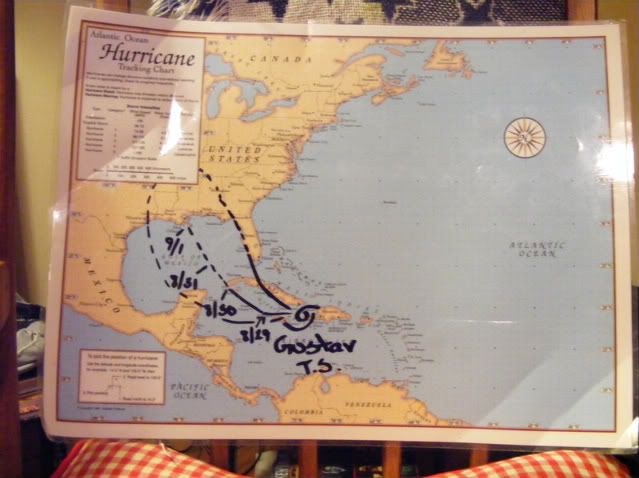
It's projected 5-day track has it making landfall (at hurricane strength) at the Louisiana/ Mississippi border... right where Katrina made landfall three years ago. I attempted to comfort Primo by pointing out that the area where we live is covered by the map key. "The makers of a hurricane tracking chart wouldn't cover an area with the key if hurricanes frequently hit that area, would they?" She's still made plans for tomorrow.
Tomorrow, we'll be checking to make sure our emergency kit is up to date... replacing any expired canned goods (or at least making a shopping list), putting in fresh batteries, making sure changes of clothes will actually fit everyone, removing the diapers we put in for Quarto now that he's potty trained and replace them with a couple of "just in case" pull-ups, and making sure we have supplies and contact info for the two kids we watch during the day. We'll also:
-change the back-up battery in the weather alert radio and make sure our hand-crank radio and flashlights are easily accessible (and the flashlights have fresh batteries)
-set aside some containers to fill with drinking water should it look like we'll need it
-review what to do in case of an emergency
-read The Magic School Bus Inside a Hurricane and National Audubon Society First Field Guide: Weather (hey, we're homeschoolers; we see life's experiences as reasons to buy and read books)
-update any changes in Gustav's status and track on the hurricane chart
-be shushed by Primo every time the weather report comes on the radio
We are diligently trying to put into practice what Terzo learned in Cub Scouts (particularly during our family emergency preparedness sessions): Be Prepared
As Sun Tzu stated in The Art of War (and as I am trying to impart to Primo through this study of hurricanes and emergency preparedness):
So it is said that if you know your enemies and know yourself, you will fight without danger in battles. If you know only yourself, but not your opponent, you may win or may lose. If you know neither yourself nor your enemy, you will always endanger yourself.
Tuesday, August 26, 2008
Yes, Minister... Mr. Secretary... Mr. President
Not sure whether to laugh or cry. Maybe we can take comfort in the fact that at least we're not alone... nope, still leaning towards crying... or at least fist-pounding. (And I'm definitely laughing. This is great stuff. Gotta love British sitcoms.)
If you've never seen the British television series Yes, Minister and Yes, Prime Minister, I highly recommend them. You are missing quite a treat.
HT: Consent of the Governed - thanks for the reminder)
If you've never seen the British television series Yes, Minister and Yes, Prime Minister, I highly recommend them. You are missing quite a treat.
HT: Consent of the Governed - thanks for the reminder)
Saturday, June 07, 2008
Little Serendipities Go A Long Way
I am a planner by nature. If I find out that we are traveling somewhere (and it doesn't have to be far; if we are going to be away from home for more than a couple of hours, that's enough) or having company, out come the paper and pencil, I pull up MapQuest and Google on the computer, and the research and planning begin. And although I get great pleasure out of planning little (and big) excursions, it is often those little serendipities that provide the most pleasure and the greatest memories. We recently experienced one of these little serendipities, and I know it is something I will always remember.
My parents came to visit a few weeks ago. They had never been to our new place here in Dixie, and since our new home is over 1,000 miles from their place, we haven't seen each other in almost a year. With the price of gas soaring as it is, who knows when we'll get together again, so I decided to try and plan some short trips that would give them a good taste of the area in their short trip plus include some places our family hadn't had a chance to explore yet. One of the places we went was the University Museum. Our family had been there before, but it is quite an impressive little museum. They have a wonderful antiquities collection that includes pottery, coins, mosaics, and busts as well as a doll collection, a Civil War (or should I say "War Between the States" or "War of Northern Aggression") collection, a small but broadly representational art collection, and a collection of historical scientific instruments that my children always find fascinating and wish they could touch. Tucked off on the side is a small room that usually houses a temporary exhibit. Terzo was very disappointed when he investigated back there this time and found that the Art of the Faulkners exhibit that we had seen on our last trip was gone. "Now it's just some old books," he lamented to me. Not connecting his statement with some information Frodo had given me earlier in the semester, I took my time moseying back to the exhibit and stood only feet from it is a I re-examined a sketch created and autographed by Kurt Vonnegut that is part of the museum's regular collection. Frodo was just behind me as I finally made my way to the "old books" and I could hear him gasp as we entered, "These are the Remnant Trust books. Remember, Hon, I told you about these? Cool."
At the beginning of the spring semester, Frodo mentioned that the University was going to host a tour by the Remnant Trust. The tour consisted of books considered significant because of their age, rarity, or influence on the world, but even cooler, you not only got to see the books, but you also got to touch them. When I went to the University Museum's website to see if I could take the kids over to leek at the books, I came across this notice:
Drat. We weren't going to be able to go. Frodo was hoping to arrange a time for his university students to go to the exhibit, but he wasn't able to get a hold of the correct person to arrange an appointment. With the end of the semester, we figured his chance to view the exhibit had gone.
Fast forward to my parents' visit two weeks after the semester ended. The RT was late in picking up the collection, so the University Museum still had it on display! As we were oohing and aahing over the books in the display cases, a museum employee approached us and asked if we wanted the curator to open the cases for us and give us a closer look at the books. Minutes later, we were getting a personal lesson on the books on display.

This is the curator showing us a handwritten, illuminated manuscript (on parchment, I might add) of the Magna Carta from 1350. 1350!
Then, it got even better:
 That's Frodo and Primo holding and casually thumbing through a handwritten, illuminated manuscript of the Magna Carta from 1350. How cool is that?!
 Here is a closer view. (Handwritten! 1350! Did I mention that it was handwritten and illuminated on parchment in 1350?)
The curator shared the books in all the display cases then left them open for us to go back and pick up and leaf through the ones we wanted and to ask questions.
What other books were there? Well...
 Secondo's favorite was the illuminated copy of St. Augustine's City of God c. 1494 (two short years after "in 1492 Columbus sailed the ocean blue.")

I tried to take a picture of her flipping through it, but every time she suspected she was being watched, she took her hands off the book. See, here she is doing the "Me? I wasn't touching the book. I was just standing here rubbing my eye" move. I think she had "don't touch the exhibits" going through her head no matter how many times we were told to feel free to pick up and examine the books.
 A first edition of Thomas Paine's Common Sense... printed in England in 1776.

If you ask Primo which book was her favorite, she will tell you it was this one, Summa Theologica Pars Secunda c. 1497. From the accompanying plaque:

See the large blanks in the copy? This copy was supposed to be illuminated, but apparently no one got around to it.

Although she says Aquinas' book was her favorite, Primo spent most of her time paging through this 1862 copy of William the Conqueror's Doomsday Book.

Terzo's favorite was this print of the Boston Massacre made from the plate created by Paul Revere and his silversmiths. (The curator was impressed that Primo knew that the Boston Massacre was instigated by the children of Patriots, and some Patriots, throwing snowballs at the British soldiers... although something was bound to happen sooner or later after months of military occupation in Boston.)
Frodo had a hard time nailing down a favorite. Besides City of God, the Magna Carta, and Summa Theologica which I have already shared, he probably would list the two works by Frederick Douglass that were included in the display.

Narrative of the Life of Frederick Douglass (1945)

My Bondage & My Freedom (1855) signed by Frederick Douglass
On the top of a list of Frodo's favorites, if he had been forced to rank them, would have been the copy of John Calvin's Institutes printed in 1578. William Shakespeare was apprenticing at the print shop where this edition was printed and probably set some of the type for the volume. Unfortunately, I don't have a picture of the book. I got a picture of the plaque, but not the book. (Mom, do you have a picture of Calvin's Institutes?) Not sure how that happened. I was probably distracted by my favorites in the collection.

William Penn's The Great Case of Liberty of Conscience c. 1670.
I was also amazed to see the Minutes of the Second Continental Congress from 1778 and the Illinois broadside of the Emancipation Proclamation signed by Abraham Lincoln. (Each president signed all broadsides sent to his home state.) I couldn't get a good picture of the broadside because it was framed under glass, and I have no idea why I don't have a picture of the minutes. (Mom? Did you get one?)

Other books in the collection were William Blackstone's Commentaries on the Law, 1771 (above), Mary Wollstonecraft's A Vindication on the Rights of Women, Benjamin Franklin's Pennsylvania Anti-Slavery Document (1787), and Letters Concerning the English Nation (1733) by Voltaire.
What a great day!
My parents came to visit a few weeks ago. They had never been to our new place here in Dixie, and since our new home is over 1,000 miles from their place, we haven't seen each other in almost a year. With the price of gas soaring as it is, who knows when we'll get together again, so I decided to try and plan some short trips that would give them a good taste of the area in their short trip plus include some places our family hadn't had a chance to explore yet. One of the places we went was the University Museum. Our family had been there before, but it is quite an impressive little museum. They have a wonderful antiquities collection that includes pottery, coins, mosaics, and busts as well as a doll collection, a Civil War (or should I say "War Between the States" or "War of Northern Aggression") collection, a small but broadly representational art collection, and a collection of historical scientific instruments that my children always find fascinating and wish they could touch. Tucked off on the side is a small room that usually houses a temporary exhibit. Terzo was very disappointed when he investigated back there this time and found that the Art of the Faulkners exhibit that we had seen on our last trip was gone. "Now it's just some old books," he lamented to me. Not connecting his statement with some information Frodo had given me earlier in the semester, I took my time moseying back to the exhibit and stood only feet from it is a I re-examined a sketch created and autographed by Kurt Vonnegut that is part of the museum's regular collection. Frodo was just behind me as I finally made my way to the "old books" and I could hear him gasp as we entered, "These are the Remnant Trust books. Remember, Hon, I told you about these? Cool."
At the beginning of the spring semester, Frodo mentioned that the University was going to host a tour by the Remnant Trust. The tour consisted of books considered significant because of their age, rarity, or influence on the world, but even cooler, you not only got to see the books, but you also got to touch them. When I went to the University Museum's website to see if I could take the kids over to leek at the books, I came across this notice:
These books are available for professors to use in their classes under supervision in the museum. The books cannot be removed from the museum. We can accommodate groups up to 70 in our [gallery], up to 40 in our classroom and up to 10 in our board room. For larger classes special arrangements may be possible. We need two weeks notice to arrange to host your class at the museum. Our regular hours are 9:30-4:30 Tues.-Sat. We will try to accommodate classes that meet outside of those hours when ever possible but we cannot guarantee that. Call... to book a class.
Drat. We weren't going to be able to go. Frodo was hoping to arrange a time for his university students to go to the exhibit, but he wasn't able to get a hold of the correct person to arrange an appointment. With the end of the semester, we figured his chance to view the exhibit had gone.
Fast forward to my parents' visit two weeks after the semester ended. The RT was late in picking up the collection, so the University Museum still had it on display! As we were oohing and aahing over the books in the display cases, a museum employee approached us and asked if we wanted the curator to open the cases for us and give us a closer look at the books. Minutes later, we were getting a personal lesson on the books on display.

This is the curator showing us a handwritten, illuminated manuscript (on parchment, I might add) of the Magna Carta from 1350. 1350!
Then, it got even better:
 That's Frodo and Primo holding and casually thumbing through a handwritten, illuminated manuscript of the Magna Carta from 1350. How cool is that?!
 Here is a closer view. (Handwritten! 1350! Did I mention that it was handwritten and illuminated on parchment in 1350?)
The curator shared the books in all the display cases then left them open for us to go back and pick up and leaf through the ones we wanted and to ask questions.
What other books were there? Well...
 Secondo's favorite was the illuminated copy of St. Augustine's City of God c. 1494 (two short years after "in 1492 Columbus sailed the ocean blue.")
I tried to take a picture of her flipping through it, but every time she suspected she was being watched, she took her hands off the book. See, here she is doing the "Me? I wasn't touching the book. I was just standing here rubbing my eye" move. I think she had "don't touch the exhibits" going through her head no matter how many times we were told to feel free to pick up and examine the books.
 A first edition of Thomas Paine's Common Sense... printed in England in 1776.
If you ask Primo which book was her favorite, she will tell you it was this one, Summa Theologica Pars Secunda c. 1497. From the accompanying plaque:
"One of only three known copies in the world. One in the British Museum in London and the other in the Newbury in Chicago. This is the most perfect of the three."

See the large blanks in the copy? This copy was supposed to be illuminated, but apparently no one got around to it.

Although she says Aquinas' book was her favorite, Primo spent most of her time paging through this 1862 copy of William the Conqueror's Doomsday Book.

Terzo's favorite was this print of the Boston Massacre made from the plate created by Paul Revere and his silversmiths. (The curator was impressed that Primo knew that the Boston Massacre was instigated by the children of Patriots, and some Patriots, throwing snowballs at the British soldiers... although something was bound to happen sooner or later after months of military occupation in Boston.)
Frodo had a hard time nailing down a favorite. Besides City of God, the Magna Carta, and Summa Theologica which I have already shared, he probably would list the two works by Frederick Douglass that were included in the display.

Narrative of the Life of Frederick Douglass (1945)

My Bondage & My Freedom (1855) signed by Frederick Douglass
On the top of a list of Frodo's favorites, if he had been forced to rank them, would have been the copy of John Calvin's Institutes printed in 1578. William Shakespeare was apprenticing at the print shop where this edition was printed and probably set some of the type for the volume. Unfortunately, I don't have a picture of the book. I got a picture of the plaque, but not the book. (Mom, do you have a picture of Calvin's Institutes?) Not sure how that happened. I was probably distracted by my favorites in the collection.

William Penn's The Great Case of Liberty of Conscience c. 1670.
I was also amazed to see the Minutes of the Second Continental Congress from 1778 and the Illinois broadside of the Emancipation Proclamation signed by Abraham Lincoln. (Each president signed all broadsides sent to his home state.) I couldn't get a good picture of the broadside because it was framed under glass, and I have no idea why I don't have a picture of the minutes. (Mom? Did you get one?)

Other books in the collection were William Blackstone's Commentaries on the Law, 1771 (above), Mary Wollstonecraft's A Vindication on the Rights of Women, Benjamin Franklin's Pennsylvania Anti-Slavery Document (1787), and Letters Concerning the English Nation (1733) by Voltaire.
What a great day!
Tuesday, May 27, 2008
Fly on the Wall
Terzo: Mom, can we do that game where you read me stuff, and I write stuff?
Me: Um, what?
Terzo: You know, that game where you read me stuff out of that book, and I have a pencil and a piece of paper and write stuff you tell me. Then you take a red pen and write some of the things I wrote wrong right, so I have to write them again, but when I get them right, you use the red pen to write big C's next to them then you hug me! Can we play that game? Please!
Me: You mean a spelling test? Sure, I can give you a spelling test.
Terzo: Yay! I like the spelling test game!
Me: Um, what?
Terzo: You know, that game where you read me stuff out of that book, and I have a pencil and a piece of paper and write stuff you tell me. Then you take a red pen and write some of the things I wrote wrong right, so I have to write them again, but when I get them right, you use the red pen to write big C's next to them then you hug me! Can we play that game? Please!
Me: You mean a spelling test? Sure, I can give you a spelling test.
Terzo: Yay! I like the spelling test game!
Thursday, February 14, 2008
Stinkin' English
English can be a difficult language to figure out the spelling rules for. A couple days ago, the girls hit a pluralizing review and Terzo hit the "i before e" rule on the same day. Listening to Frodo review plurals and witnessing Terzo's frustration reminded me of this sketch my Brian Regan. Enjoy!
Saturday, October 20, 2007
Free Online Foreign Language Program - Mango
I have heard the benefits of the computer-based foreign language program, Rosetta Stone, touted on homeschool blogs, educational magazines, homeschool message boards, homeschool conferences, news stories, and now television and radio commercials. Many libraries have purchased it and have it available online for their patrons. (Or so I've heard. None of the library systems we've had access to provide it. Sigh.) I've looked at purchasing it, but it was far outside our budget. So was their online version. I've considered getting an out-of-area library card for a system that has it, but it was a hassle.
Now I need fret no more. I just learned of an online, FREE foreign language program called Mango that we are going to try. For native English speakers, they offer :
Brazilian Portuguese
Italian
Greek
Spanish
Mandarin Chinese
French
German
Russian
Japanese
Pig Latin (yes, you read that right... I mean, esyay, ouyay eadray atthay ightray)
I'm leaning toward French, Spanish or Mandarin Chinese for the kids. I really wanted to learn Swahili with Rosetta Stone. Maybe I can suggest it to the Mango people.
What language are you going to try?
Now I need fret no more. I just learned of an online, FREE foreign language program called Mango that we are going to try. For native English speakers, they offer :
Brazilian Portuguese
Italian
Greek
Spanish
Mandarin Chinese
French
German
Russian
Japanese
Pig Latin (yes, you read that right... I mean, esyay, ouyay eadray atthay ightray)
I'm leaning toward French, Spanish or Mandarin Chinese for the kids. I really wanted to learn Swahili with Rosetta Stone. Maybe I can suggest it to the Mango people.
What language are you going to try?
Wednesday, October 17, 2007
A Heretical Thought?
Henry, over at Why Homeschool, has an insightful article speculating on when the decline in the quality of American education began.
October 4th was the 50th anniversary of Sputnik. In 1957 the Soviet Union was the first nation to put a satellite into orbit. This exciting event caught the rest of the world by surprise.
At the time many in the United States claimed there was a need to respond, that the United States needed to prove they could do better and thus sprang the beginning of the effort to put a man on the moon. Another response was greater state and federal government interference in education. Like chicken littles, they said the sky was falling and justified dramatic and increasing changes in education.
Thursday, September 06, 2007
School Officials Fail Constitution 101
Apparently the first amendment doesn't apply in government schools. I must have missed the "Caution: You Are Entering A Constitution-Free Zone" signs.
Wait... it doesn't stop there.
You can read the article in its entirety here.
So, what are the lessons that the school is teaching to its students (and the the court apparently believes should apply to everyone)?
1. You have a first amendment right to free speech as long as you don't offend someone in authority. (Assuming that said authority works for the government.)
2. If you offend someone in authority, that authority has the right to openly discriminate against you and use their power to enforce that discrimination.
3. You may not stand in support of anyone who has offended a shared authority or you will be treated like a co-offender and have your constitutional and positional rights (in this case, the right to participate in school elections and the right to free speech) taken away.
4. The judicial power of school authorities is equivalent to that of local police and magistrates and extends to all spheres of life and not just the area over which they have been hired, appointed or elected to oversee.
5. That we are a government of the government, by the government and for the government.
6. It takes a government to raise a child.
What do the parents of Avery Doninger and the other students at Lewis S. Mills High School have the opportunity to teach their children?
HT: Judy at Consent of the Governed
Mom defends daughter's right to blog speech
By Brigitte Ruthman
Waterbury Republican-American
Sept. 5, 2007
NEW HAVEN -- Poised, intelligent and articulate as she may be, 17-year-old senior Avery Doninger was outside her legal bounds when she used derogatory language to describe administrators at Lewis S. Mills High School, a federal judge has found.
U.S. District Judge Mark R. Kravitz's precedent-setting decision Friday to uphold the school administration's decision to punish Doninger for a blog entry she made outside of school in April chips away at First Amendment rights, her mother Lauren and her attorney Jon L. Schoenhorn said.
Wait... it doesn't stop there.
As punishment, school officials at the 2,843-student kindergarten through 12 school district covering Burlington and Harwinton prohibited Doninger from running for class secretary for a year, a position she had held since her freshman year. Despite the ruling, Doninger would have won her seat back this year because so many students voted for her as a write-in candidate. The school ignored the write-in support, a decision her supporters claim violated their right of free choice. Students were prohibited from wearing T-shirts emblazoned with "Team Avery."
You can read the article in its entirety here.
So, what are the lessons that the school is teaching to its students (and the the court apparently believes should apply to everyone)?
1. You have a first amendment right to free speech as long as you don't offend someone in authority. (Assuming that said authority works for the government.)
2. If you offend someone in authority, that authority has the right to openly discriminate against you and use their power to enforce that discrimination.
3. You may not stand in support of anyone who has offended a shared authority or you will be treated like a co-offender and have your constitutional and positional rights (in this case, the right to participate in school elections and the right to free speech) taken away.
4. The judicial power of school authorities is equivalent to that of local police and magistrates and extends to all spheres of life and not just the area over which they have been hired, appointed or elected to oversee.
5. That we are a government of the government, by the government and for the government.
6. It takes a government to raise a child.
What do the parents of Avery Doninger and the other students at Lewis S. Mills High School have the opportunity to teach their children?
Unjust laws exist: shall we be content to obey them, or shall we endeavor to amend them, and obey them until we have succeeded, or shall we transgress them at once? Men, generally, under such a government as this, think that they ought to wait until they have persuaded the majority to alter them. They think that, if they should resist, the remedy would be worse than the evil. But it is the fault of the government itself that the remedy is worse than the evil. It makes it worse. Why is it not more apt to anticipate and provide for reform? Why does it not cherish its wise minority? Why does it cry and resist before it is hurt? Why does it not encourage its citizens to put out its faults, and do better than it would have them? Why does it always crucify Christ and excommunicate Copernicus and Luther, and pronounce Washington and Franklin rebels?
...The authority of government, even such as I am willing to submit to — for I will cheerfully obey those who know and can do better than I, and in many things even those who neither know nor can do so well — is still an impure one: to be strictly just, it must have the sanction and consent of the governed. It can have no pure right over my person and property but what I concede to it. The progress from an absolute to a limited monarchy, from a limited monarchy to a democracy, is a progress toward a true respect for the individual. Even the Chinese philosopher was wise enough to regard the individual as the basis of the empire. Is a democracy, such as we know it, the last improvement possible in government? Is it not possible to take a step further towards recognizing and organizing the rights of man? There will never be a really free and enlightened State until the State comes to recognize the individual as a higher and independent power, from which all its own power and authority are derived, and treats him accordingly. I please myself with imagining a State at last which can afford to be just to all men, and to treat the individual with respect as a neighbor; which even would not think it inconsistent with its own repose if a few were to live aloof from it, not meddling with it, nor embraced by it, who fulfilled all the duties of neighbors and fellow men. A State which bore this kind of fruit, and suffered it to drop off as fast as it ripened, would prepare the way for a still more perfect and glorious State, which I have also imagined, but not yet anywhere seen.- from "On the Duty of Civil Disobedience"
by Henry David Thoreau
Tuesday, September 04, 2007
It's because of days like this...
Technically, we have a schedule. It’s a loose one (a living document of sorts), but it’s a schedule… goals for the year, for the semester, for the week, for the day. Some days, the schedule bends and twists and some days we just put our fingers in our ears, hum, and pretend we don’t know it’s there. These days may be light on “school” but they’re heavy with education. Today was one of those days.
While checking the news for a weather update, a story came on about the conviction of a high school student (the first of 6 to go on trial) after a series of escalating race-related violence at the high school in
“Remember the end of Oh Brother, Where Art Thou? when the four men are standing under the tree and there are ropes with loops above their heads hanging from the tree? Those are nooses.” (Praise God for movies! They can be such a great teaching tool.)
“But why were the kids mad about the nooses in the tree?”
Thus began our impromptu lesson on the American involvement in the slave trade, the Civil War, the KKK (with more references to Oh Brother, Where Art Thou?), Dr. Martin Luther King, Jr., Rosa Parks, and the Civil Rights Movement… the elementary level, Cliff Notes version.
During lunch, Primo mentioned the movie Flushed Away, which we watched over the weekend. “What other movies have we seen that take place in
“Where do llamas live?”
“Where are ponchos part of the traditional costume?”
“Who built step temples?”
We finally have it narrowed down to ancient Central or
Secondo hops up from the table to go check the world map that we have posted in the hall. I assume she is going to find
This leads to a discussion of the coolest sounding place names (which, of course, we look-up on the map).
Yes, we had “school” today, too. Latin finally clicked… yay! And Quarto stunned us all during our Bible time. For Bible, we alternate time between Veritas Press Bible Cards and Training Hearts, Teaching Minds (which goes through the Westminster Shorter Catechism). Today, we reviewed question 21. Secondo answered first (only getting stuck once), but I noticed that Quarto’s mouth was moving along with Secondo’s answer. Terzo’s turn came next, and again Quarto’s mouth was moving through the answer. When Terzo was done, I asked Frodo to let Quarto go next:
Frodo: Who is the redeemer of God’s chosen ones?
Quarto: The only redeemer of God’s chosen is the Lord Jesus Christ, the eternal Son of God… um
Me: Wh…
Quarto: …who became man. He was and continues to be God and man in two dis… dis…
Me: Tuh
Quarto: … distinct natures and one person forever.
Ha! He did better than I did!
I love days like this! This is why we homeschool.
Note: Frodo felt the need to add to our "adult education" by sharing with me what a merkin is. Apparently, this came up in the Shakespeare class he is TA-ing. (BTW, from now on I am calling Shakespeare the "Baudy Bard".) There are just some things you don't need to know. Seriously, if you feel the need to look it up, I don't recommend having the kids around. Aren't you glad I mentioned it? *wry grin*
Tuesday, August 21, 2007
4 Ways to Spend Money
I was visiting a homeschool message board today where a mom shared that some of her friends who send their kids to government school were discussing the long lists of supplies the kids were expected to bring the first day of school. I understand students being required to bring items like pencils, paper, crayons, etc. I even understand the teacher requiring that students bring certain colors or styles of items... to avoid competition over who has the nicer notebook or to teach children how to better organize their schoolwork by organizing assignments in different colored folders. However, what I don't get are 1) the collecting of items and putting them in a communal group to be dispersed by the teacher later and 2) the requirement of students to bring truly "classroom" supplies... like tissues, dry erase markers, and toilet paper. Isn't that the cost of providing education? Shouldn't these items be included in the school's budget? We spend just over $8000 per student on average for government education (according to 2002-2003 school year stats kept by the Dept. of Ed). We can't afford toilet paper with that?!
I have to admit that I am a bit cynical (maybe that's an understatement. LOL!) when it comes to lists like this. A coworker of dh's had a kid in the local government school, and his dd told him that she had to stand in line every morning to sharpen two of her pencils in the classroom next door since there was no sharpener in her room. The father, assuming his dd was exaggerating, asked the teacher about it the next time he saw her. Sure enough, the teacher confirmed that there was no sharpener in her room because it wasn't provided for in the budget. The dad offered to buy one for the classroom, and the teacher asked him not to because when the school board toured the school at the end of the year while they were writing up the next year's budget and assessing what was needed, they would see that her classroom had a sharpener and not provide as much money in the budget for classroom expenses as they did the year before! The teachers were purposely lacking in supplies so that they could complain about what they didn't have and get money. What they were spending it on, I have no idea.
This reminds me of Milton Friedman's list of the four ways to spend money (the humorous examples in this version of the list that follows is by PJ O'Rourke from his book All the Trouble in the World: The Lighter Side of Overpopulation, Famine, Ecological Disaster, Ethnic Hatred, Plague and Poverty):
The government schools (well, let's face it, I could just say "the government" and leave it at that) is functioning under #4.
There is one benefit to these back-to-school lists, though. Back-to-school sales. I love to stock-up on school supplies at the end of summer. Wading through aisles and aisles of neatly packed reams of paper, colorful boxes of crayons, and 3-ring-binders that just scream, "Buy me!" (Well, they don't really scream, but this is what I tell Frodo to justify my purchases. LOL!) But even with my addiction to the smell of newly-sharpened #2's and eraser rubber, we spend considerably less per student than the local government school. About $200 per student. I know that doesn't include costs like rent, electricity, salary, and such, but the Department of Education's cost estimates don't include pencils, crayons or toilet paper, so I'm guessing we're still much lower.
Off my soapbox. :)
I have to admit that I am a bit cynical (maybe that's an understatement. LOL!) when it comes to lists like this. A coworker of dh's had a kid in the local government school, and his dd told him that she had to stand in line every morning to sharpen two of her pencils in the classroom next door since there was no sharpener in her room. The father, assuming his dd was exaggerating, asked the teacher about it the next time he saw her. Sure enough, the teacher confirmed that there was no sharpener in her room because it wasn't provided for in the budget. The dad offered to buy one for the classroom, and the teacher asked him not to because when the school board toured the school at the end of the year while they were writing up the next year's budget and assessing what was needed, they would see that her classroom had a sharpener and not provide as much money in the budget for classroom expenses as they did the year before! The teachers were purposely lacking in supplies so that they could complain about what they didn't have and get money. What they were spending it on, I have no idea.
This reminds me of Milton Friedman's list of the four ways to spend money (the humorous examples in this version of the list that follows is by PJ O'Rourke from his book All the Trouble in the World: The Lighter Side of Overpopulation, Famine, Ecological Disaster, Ethnic Hatred, Plague and Poverty):
- You spend your money on yourself. You're motivated to get the thing you want most at the best price. This is the way middle-aged men haggle with Porsche dealers.
- You spend your money on other people. You still want a bargain, but you're less interested in pleasing the recipient of your largesse. This is why children get underwear at Christmas.
- You spend other people's money on yourself. You get what you want but price no longer matters. The second wives who ride around with the middle-aged men in the Porsches do this kind of spending at Neiman Marcus.
- You spend other people's money on other people. And in this case, who gives a s**t?
The government schools (well, let's face it, I could just say "the government" and leave it at that) is functioning under #4.
There is one benefit to these back-to-school lists, though. Back-to-school sales. I love to stock-up on school supplies at the end of summer. Wading through aisles and aisles of neatly packed reams of paper, colorful boxes of crayons, and 3-ring-binders that just scream, "Buy me!" (Well, they don't really scream, but this is what I tell Frodo to justify my purchases. LOL!) But even with my addiction to the smell of newly-sharpened #2's and eraser rubber, we spend considerably less per student than the local government school. About $200 per student. I know that doesn't include costs like rent, electricity, salary, and such, but the Department of Education's cost estimates don't include pencils, crayons or toilet paper, so I'm guessing we're still much lower.
Off my soapbox. :)
Wednesday, August 15, 2007
Still In Shock
As some of you already know, I have been working on writing an elementary-level science curriculum for a little while now. I have a science background (Biology & Forensic Science), and I wasn't pleased with the curricula available to homeschoolers. Specifically, classical homeschoolers. I wanted something that followed a classical, taxonomic approach without having to build as I went. Well, I ended up having to build it, but thought it could be even better, more concise and easier to use, so I started writing. (Frodo is so wonderful. When I told him I wanted to write a science curriculum, he bought me a laptop for my birthday and has perfected the nagging/ encouraging dance to help keep me motivated.)
I'm not sure what possessed me to time it this way, but a couple weeks before we moved, I sent some query letters to a couple of publishers to see if they'd be interested in publishing the curriculum once it was finished (I am about 1/3 through writing the first of four volumes). One publisher contacted me in mere days asking for a proposal and sample chapters. Less than a week before we moved, I met with the publisher face-to-face. About 5 minutes before we were planning to hit the road with the moving van, the publisher called. They wanted to publish the curriculum!
I just signed the Memorandum of Understanding for the first two volumes. With God's blessing, they will be ready by late spring/ early summer 2008. (I'll share more details as I learn them.)
So, if you don't see me around here often, it's because I'm writing... or teaching... or cleaning... or sleeping.
If you do see me around here often (I'll be around some... for "me" time), join Frodo in his dance of nagging and encouraging and remind me to get to work! :)
I'm not sure what possessed me to time it this way, but a couple weeks before we moved, I sent some query letters to a couple of publishers to see if they'd be interested in publishing the curriculum once it was finished (I am about 1/3 through writing the first of four volumes). One publisher contacted me in mere days asking for a proposal and sample chapters. Less than a week before we moved, I met with the publisher face-to-face. About 5 minutes before we were planning to hit the road with the moving van, the publisher called. They wanted to publish the curriculum!
I just signed the Memorandum of Understanding for the first two volumes. With God's blessing, they will be ready by late spring/ early summer 2008. (I'll share more details as I learn them.)
So, if you don't see me around here often, it's because I'm writing... or teaching... or cleaning... or sleeping.
If you do see me around here often (I'll be around some... for "me" time), join Frodo in his dance of nagging and encouraging and remind me to get to work! :)
Wednesday, August 08, 2007
Not As Easy As I Thought It Would Be
As I mentioned here, one of the positives I saw in our recent move was less-intrusive homeschooling laws as compared to the state we just left. All I have to do here is pick-up a form where I provide the kids' names, ages and grades, the fact that they are homeschooled and the location where school is taking place. Sounds simple enough, right?
A little over a week ago, I called the office of our School Superintendent to find out when and where I could pick-up the necessary form (it needs to be in by mid-September, but I wanted to get it filed while I was thinking about it and was trying to avoid driving over to the school while school was in session... the government schools started this past Monday.) I was told that the Attendance Officer handles such matters, and I would have to speak to her. The receptionist at the Superintendent's office was very nice and gave me the name and number of the Attendance Officer then forwarded my call to her office. There was no answer, and I didn't bother to leave a message since I realized I was calling during the lunch hour and figured I would just call back after lunch. About an hour later I call back and there is still no answer, so I leave a message asking where the office is located and when would be the best time to stop by to pick up the form.
Fast forward a few days. I still haven't received a response from my phone call, but I have figured out where the office is, so we decide to stop by while we are out running errands. We drive around the school campus (it's pretty big since it houses the county's elementary, middle, and high schools plus all of the county school district's offices and athletic fields), and we can't find the office anywhere. We find the Superintendent's office, so I decide to see if someone there can point me in the right direction. Again, the receptionist is very nice. She tells me where to find the office (an unmarked trailer that we passed a few times), but tells me that she doesn't think that the Attendance Officer is in today. She calls over to check, and sure enough, no one answers. While she writes down the number for me, she sighs and says, "I have no idea what her office hours are. She is a state employee, not a school district employee, and I haven't figured out her hours yet. She comes when she wants, I guess." With that disheartening piece of information, I thank her and go home.
I have called once since then and still have heard no response. I am planning on calling again tomorrow and leaving another message, but I am not sure what else I can try after that.
Less intrusive? I guess so (until I fail to fill-in the form and find the Attendance Officer at my door).
Easier? Nope.
A little over a week ago, I called the office of our School Superintendent to find out when and where I could pick-up the necessary form (it needs to be in by mid-September, but I wanted to get it filed while I was thinking about it and was trying to avoid driving over to the school while school was in session... the government schools started this past Monday.) I was told that the Attendance Officer handles such matters, and I would have to speak to her. The receptionist at the Superintendent's office was very nice and gave me the name and number of the Attendance Officer then forwarded my call to her office. There was no answer, and I didn't bother to leave a message since I realized I was calling during the lunch hour and figured I would just call back after lunch. About an hour later I call back and there is still no answer, so I leave a message asking where the office is located and when would be the best time to stop by to pick up the form.
Fast forward a few days. I still haven't received a response from my phone call, but I have figured out where the office is, so we decide to stop by while we are out running errands. We drive around the school campus (it's pretty big since it houses the county's elementary, middle, and high schools plus all of the county school district's offices and athletic fields), and we can't find the office anywhere. We find the Superintendent's office, so I decide to see if someone there can point me in the right direction. Again, the receptionist is very nice. She tells me where to find the office (an unmarked trailer that we passed a few times), but tells me that she doesn't think that the Attendance Officer is in today. She calls over to check, and sure enough, no one answers. While she writes down the number for me, she sighs and says, "I have no idea what her office hours are. She is a state employee, not a school district employee, and I haven't figured out her hours yet. She comes when she wants, I guess." With that disheartening piece of information, I thank her and go home.
I have called once since then and still have heard no response. I am planning on calling again tomorrow and leaving another message, but I am not sure what else I can try after that.
Less intrusive? I guess so (until I fail to fill-in the form and find the Attendance Officer at my door).
Easier? Nope.
Thursday, May 31, 2007
We're done!
Well, I don't think we're done, but standardized testing is done, the portfolios have been reviewed (twice) and we have our very official-looking letter from the school district saying that we are done and that Primo has passed fourth grade and Secondo passed third grade and that's what matters, right? In case you're curious, this is what their letters actually say:
We are moving out of the state at the end of next month. Although I will admit that the portfolio requirement did get me into the habit of collecting work samples, art samples and photos and putting them into a scrapbook (I am terrible at taking pictures much less printing them and putting them into albums that I could take out and prove that I took them), the state homeschooling requirements here are amazingly intrusive, and I will not miss them one bit. Here is what we have to file in a nutshell:
1. A notarized affidavit with the local school superintendent prior to beginning the home education program and by August 1st each year thereafter for each child who turns 8 within 2 weeks of the start of the district's school year through age 17. This affidavit must be accompanied by:
a. a list of educational objectives
b. proof of immunization or a religious exemption from immunizations
c. proof of health and medical services (including height and weight measurements, annual hearing check, a vision check, physical exams at the start of homeschooling as well as the beginning of grades 6 and 11, and dental exams at the start of homeschooling and when beginning grades 3 and 7).
2. Attendance of 180 days or 900 hours must be kept during the year
3. Proof that the following subjects were taught at the elementary level: English (including spelling, reading and writing), Arithmetic, US and PA History, Civics, Health and Physiology, Pys Ed, Music, Art, Geography, Science, Safety and Fire Prevention
4. Standardized tests must be given in grades 3, 5, and 8
5. A log "made contemporaneously with the instruction" listing all reading materials used (listed by title).
6. A portfolio which should include:
a. the log
b. the attendance record
c. a copy of the outside evaluator's evaluation report (see #6) when completed
d. samples of work in all required subjects
e. copies of standardized test scores in the years required
7. An evaluation of the child and the portfolio by either a licensed clinical or school psychologist, a certified teacher, or a non-public school teacher or administrator (with at least 2 years teaching experience); the evaluator cannot be the home school supervisor or the supervisor's spouse
8. Evaluation of the portfolio by the school district superintendent or his/ her appointed liaison.
Only a little intrusive, huh? If you read the actual law yourself, you will see that there is a lot of room for interpretation... which can be a blessing or a curse for the homeschool family. For example: How many samples of work are sufficient? What proof of medical care can the State require without violating HIPPA? What form should the log take? Does it have to be dated or can it be a simple list? How detailed does the written evaluation have to be? Why do we have to file educational objectives since we aren't required to follow them? (Not that I'm complaining. All teachers know that lesson plans written at the beginning of the school year without the mess of students and weather and life almost never work out in the classroom.)
To be fair, our school district's homeschool coordinator was wonderful. I have heard very few complaints about our school district's oversight of homeschoolers (unfortunately, many nearby school districts aren't as fortunate). They are very liberal in their interpretation of the law. Our homeschool coordinator actually called me after I picked up our portfolios from the district office this week to make sure she didn't miss our affidavit for next year (most homeschoolers file the affidavit for the following year with their portfolios so they don't have to make two trips to the office... and don't forget to file on time). She was very complimentary of our home school and was sorry to hear that we were leaving the state. I will probably keep-up the maintaining of the portfolio after we move so that I have a record of the kids' work if we decide to enroll our kids in a brick-and-mortar school in the future and as an annual scrapbook.
If you are interested how our new state handles homeschooling, here are their guidelines:
That's it. No vague language that makes it difficult to comply. No potential HIPPA violations by requiring medical information. They simply want to know who and where you are so that your children won't be mistakenly declared truant. I can live with that.
As to my own standards (and Frodo's), they are much stricter than the school district's. The girls aren't exactly where I had hoped they would be in math. Everything else is on track. So even though the school district says we are done, the girls continue to work on math. School is much less formal and consistent right now since we are preparing to move, but the flash cards and math books come out fairly regularly. The kids were a little dismayed at first to see me packing a "school bag" so that we could continue school while we prepared to move, but they are fine with it now that they have experienced "moving school". The bag has math flash cards, math books, some math manipulatives, a pile of field guides, coloring books that cover the history and facts about our new state, atlases, and two novels each that the girls should have finished by the end of July. School will be back in full-swing beginning August 1st.
So, I guess we aren't "done." Just hibernating.
Dear Ms. Frodo-
This letter is to verify that upon review of the portfolio materials and home school evaluation, it is my opinion that [Primo/ Secondo] has met the requirements of a home schooling program and satisfactorily progressed to be promoted to the next level of education appropriate for your child.
Sincerely,
[Superintendent of the Local School District]
We are moving out of the state at the end of next month. Although I will admit that the portfolio requirement did get me into the habit of collecting work samples, art samples and photos and putting them into a scrapbook (I am terrible at taking pictures much less printing them and putting them into albums that I could take out and prove that I took them), the state homeschooling requirements here are amazingly intrusive, and I will not miss them one bit. Here is what we have to file in a nutshell:
1. A notarized affidavit with the local school superintendent prior to beginning the home education program and by August 1st each year thereafter for each child who turns 8 within 2 weeks of the start of the district's school year through age 17. This affidavit must be accompanied by:
a. a list of educational objectives
b. proof of immunization or a religious exemption from immunizations
c. proof of health and medical services (including height and weight measurements, annual hearing check, a vision check, physical exams at the start of homeschooling as well as the beginning of grades 6 and 11, and dental exams at the start of homeschooling and when beginning grades 3 and 7).
2. Attendance of 180 days or 900 hours must be kept during the year
3. Proof that the following subjects were taught at the elementary level: English (including spelling, reading and writing), Arithmetic, US and PA History, Civics, Health and Physiology, Pys Ed, Music, Art, Geography, Science, Safety and Fire Prevention
4. Standardized tests must be given in grades 3, 5, and 8
5. A log "made contemporaneously with the instruction" listing all reading materials used (listed by title).
6. A portfolio which should include:
a. the log
b. the attendance record
c. a copy of the outside evaluator's evaluation report (see #6) when completed
d. samples of work in all required subjects
e. copies of standardized test scores in the years required
7. An evaluation of the child and the portfolio by either a licensed clinical or school psychologist, a certified teacher, or a non-public school teacher or administrator (with at least 2 years teaching experience); the evaluator cannot be the home school supervisor or the supervisor's spouse
8. Evaluation of the portfolio by the school district superintendent or his/ her appointed liaison.
Only a little intrusive, huh? If you read the actual law yourself, you will see that there is a lot of room for interpretation... which can be a blessing or a curse for the homeschool family. For example: How many samples of work are sufficient? What proof of medical care can the State require without violating HIPPA? What form should the log take? Does it have to be dated or can it be a simple list? How detailed does the written evaluation have to be? Why do we have to file educational objectives since we aren't required to follow them? (Not that I'm complaining. All teachers know that lesson plans written at the beginning of the school year without the mess of students and weather and life almost never work out in the classroom.)
To be fair, our school district's homeschool coordinator was wonderful. I have heard very few complaints about our school district's oversight of homeschoolers (unfortunately, many nearby school districts aren't as fortunate). They are very liberal in their interpretation of the law. Our homeschool coordinator actually called me after I picked up our portfolios from the district office this week to make sure she didn't miss our affidavit for next year (most homeschoolers file the affidavit for the following year with their portfolios so they don't have to make two trips to the office... and don't forget to file on time). She was very complimentary of our home school and was sorry to hear that we were leaving the state. I will probably keep-up the maintaining of the portfolio after we move so that I have a record of the kids' work if we decide to enroll our kids in a brick-and-mortar school in the future and as an annual scrapbook.
If you are interested how our new state handles homeschooling, here are their guidelines:
1. Parents must file a "certificate of enrollment" by Sept. 15th which states the names, address, and phone number of parents and children (ages 6-17) involved in the homeschool and a brief description of the type of education to be offered.
2. School must be in session the "number of days that each [home] school shall require for promotion from grade to grade."
That's it. No vague language that makes it difficult to comply. No potential HIPPA violations by requiring medical information. They simply want to know who and where you are so that your children won't be mistakenly declared truant. I can live with that.
As to my own standards (and Frodo's), they are much stricter than the school district's. The girls aren't exactly where I had hoped they would be in math. Everything else is on track. So even though the school district says we are done, the girls continue to work on math. School is much less formal and consistent right now since we are preparing to move, but the flash cards and math books come out fairly regularly. The kids were a little dismayed at first to see me packing a "school bag" so that we could continue school while we prepared to move, but they are fine with it now that they have experienced "moving school". The bag has math flash cards, math books, some math manipulatives, a pile of field guides, coloring books that cover the history and facts about our new state, atlases, and two novels each that the girls should have finished by the end of July. School will be back in full-swing beginning August 1st.
So, I guess we aren't "done." Just hibernating.


Wednesday, April 04, 2007
Carnival of Education #113
I am honored to be included in this week's Carnival of Education. Go check out all the wonderful contributions at Getting Green.
Monday, April 02, 2007
Poem- When I Heard the Learn'd Astronomer by Walt Whitman
 I am posting this a day early since our schedule tomorrow is off, and I am afraid I will forget to post this because I'll be all discombobulated (I love that word). Walt Whitman it the "poster poet" for this year's Poetry Month, so I thought that one of his poems should be my next choice. This past summer, we spent a day in Washington, DC to attend the 2006 Smithsonian Folklife Festival. We made sure to schedule time into our day so we could make a side-trip to the National Portrait Gallery to see their exhibit One Life: Walt Whitman, a kosmos. The collection included excerpts of Whitman's poetry
 (scattered throughout), a first printing of Leaves of Grass, Whitman's walking stick, and photos spanning Whitman's life. By far, my favorite part of the exhibit was this photograph (right). It captures the joy, commonality, intellect, and exceptionality of Whitman. It turns out that this was Whitman's favorite photograph of himself. He called it "the Laughing Philosopher" and sent a copy of it to Alfred Lord Tennyson (then poet laureate of England). It is the perfect title.
 As homeschoolers, we often find ourselves trying to mimic the government schools so as not to appear "weird" or "unprofessional" or to make ourselves appear like a "real school". Although we have to keep our children's educations on track and make sure that they are receiving an excellent education (which often involves textbooks and schedules), we need to remember that one of the gifts of homeschooling is the flexibility to reveal and dissect the flesh of the subjects behind the textbook pages. Whitman's poem, When I Heard the Learn'd Astronomer, caught my attention because it captures the beauty of learning through the ultimate of primary sources. There are some things that cannot be learned in books. They must be experienced in the soul.
When I Heard the Learn'd Astonomer
by Walt Whitman
When I heard the learn'd astronomer;
When the proofs, the figures, were ranged in columns before me;
When I was shown the charts and the diagrams, to add, divide, and measure them;
When I, sitting, heard the astronomer, where he lectured with much applause in the lecture room,
How soon, unaccountable, I became tired and sick;
Till rising and gliding out, I wander'd off by myself,
In the mystical moist night-air, and from time to time,
Look'd up in perfect silence at the stars.
Saturday, March 31, 2007
Warning. Shameless Mommy Brag.
Alright, there is one good thing about living in the most oppressive homeschooling state in the Union. We are required to give our kids standardized tests in third, fifth and eighth grades, and thus I have government-sanctioned bragging rights.
Secondo is finishing third grade this year, so this was her first year for testing. We use the Wide-Range Achievement Test (WRAT) which gives a grade + month ability level for the subjects of reading, spelling and math. Consider yourself warned. Mommy bragging commencing in....
Three...
Two...
One...
Math - Third grade, fifth month (Right on target. We were very happy with this considering we had her change curriculum half-way through the year.)
Spelling - Fourth grade, ninth month (Have I mentioned that we really like Spelling Workout?)
Reading - Ninth grade, 0 months (The tester had Secondo skim through the word list and pick out words she thought she could read, and she was able to read a smattering of words through college level! She is so proud of herself!)
Way to go, Secondo!
Now I need to comb through the bookshelves and find more difficult books for her to read. *grin*
Secondo is finishing third grade this year, so this was her first year for testing. We use the Wide-Range Achievement Test (WRAT) which gives a grade + month ability level for the subjects of reading, spelling and math. Consider yourself warned. Mommy bragging commencing in....
Three...
Two...
One...
Math - Third grade, fifth month (Right on target. We were very happy with this considering we had her change curriculum half-way through the year.)
Spelling - Fourth grade, ninth month (Have I mentioned that we really like Spelling Workout?)
Reading - Ninth grade, 0 months (The tester had Secondo skim through the word list and pick out words she thought she could read, and she was able to read a smattering of words through college level! She is so proud of herself!)
Way to go, Secondo!
Now I need to comb through the bookshelves and find more difficult books for her to read. *grin*
Subscribe to:
Posts (Atom)