Showing posts with label poetry. Show all posts

Wednesday, September 05, 2007

Creed by Steve Turner

Creed
by Steve Turner

This is the creed I have written on behalf of all us.

We believe in Marxfreudanddarwin
We believe everything is OK
as long as you don't hurt anyone,
to the best of your definition of hurt,
and to the best of your knowledge.

We believe in sex before, during, and after marriage.
We believe in the therapy of sin.
We believe that adultery is fun.
We believe that sodomy is OK.
We believe that taboos are taboo.

We believe that everything is getting better
despite evidence to the contrary.
The evidence must be investigated
And you can prove anything with evidence.

We believe there's something in
horoscopes, UFO's and bent spoons;
Jesus was a good man
just like Buddha, Mohammed, and ourselves.
He was a good moral teacher
although we think His good morals were bad.

We believe that all religions are basically the same--
at least the one that we read was.
They all believe in love and goodness.
They only differ on matters of
creation, sin, heaven, hell, God, and salvation.

We believe that after death comes the Nothing
Because when you ask the dead what happens they say nothing.
If death is not the end, if the dead have lied,
then it's compulsory heaven for all
excepting perhaps Hitler, Stalin, and Genghis Khan.

We believe in Masters and Johnson.
What's selected is average.
What's average is normal.
What's normal is good.

We believe in total disarmament.
We believe there are direct links between warfare and bloodshed.
Americans should beat their guns into tractors
and the Russians would be sure to follow.

We believe that man is essentially good.
It's only his behavior that lets him down.
This is the fault of society.
Society is the fault of conditions.
Conditions are the fault of society.

We believe that each man must find the truth that is right for him.
Reality will adapt accordingly.
The universe will readjust.
History will alter.
We believe that there is no absolute truth
excepting the truth that there is no absolute truth.

We believe in the rejection of creeds,
and the flowering of individual thought.


"Chance" a post-script

If chance be the Father of all flesh,
disaster is his rainbow in the sky,
and when you hear

State of Emergency!
Sniper Kills Ten!
Troops on Rampage!
Whites go Looting!
Bomb Blasts School!

It is but the sound of man worshiping his maker.


as heard on The Search for Absolutes in a Pluralistic Society (Part 3 of 3) on "Let My People Think" featuring Ravi Zacharias (I downloaded the series free from iTunes)

Friday, April 27, 2007

Poem - Sonnet C by William Shakespeare

Blogger tells me that this is my 100th post, so I thought it apropos to share The Bard's 100th sonnet at this time. (Yes, I am that tired and that drained of creativity.)

Sonnet C
by William Shakespeare

WHERE art thou, Muse, that thou forget'st so long
To speak of that which gives thee all thy might?
Spend'st thou thy fury on some worthless song,
Darkening thy power to lend base subjects light?
Return, forgetful Muse, and straight redeem
In gentle numbers time so idly spent;
Sing to the ear that doth thy lays esteem
And gives thy pen both skill and argument.
Rise, resty Muse, my love's sweet face survey,
If Time have any wrinkle graven there;
If any, be a satire to decay,
Give my love fame faster than Time wastes life;
So thou prevent'st his scythe and crooked knife.


P.S. Happy belated birthday, Mr. Shakespeare. (His birthday is considered April 16, 1564. He was baptized on April 26th of the same year.)

Tuesday, April 24, 2007

Poem - Man In Space by Billy Collins

Alright, this is a totally random selection, but I find it funny and am in a rather random mood, so, you must understand, I really have no choice. (Apparently, I am in a run on sentence, comma kind of mood as well.)

You can view a video of the poem here. I highly recommend it.


Man In Space
by Billy Collins

All you have to do is listen to the way a man
sometimes talks to his wife at a table of people
and notice how intent he is on making his point
even though her lower lip is beginning to quiver,

and you will know why the women in science
fiction movies who inhabit a planet of their own
are not pictured making a salad or reading a magazine
when the men from earth arrive in their rocket,

why they are always standing in a semicircle
with their arms folded, their bare legs set apart,
their breasts protected by hard metal disks.


Monday, April 23, 2007

What is a poem?

I have never before read through the Anne of Green Gables series of books. How I missed these, I'll never know, but as I was packing the books (more on this another time) I had this overwhelming desire to read them. I came across this passage today in Anne of Avonlea where Anne and her girlfriends are discussing what poetry is. It seemed too appropriate to pass-up:

"Look, do you see that poem?"[Anne] said suddenly, pointing.

"Where?" Jane and Diana stared, as if expecting to see Runic rhymes on the birch trees.

"There... down in the brook... that old green, mossy log with the water flowing over it in those smooth ripples that look as if they'd been combed, and that single shaft of sunshine falling right athwart it, far down into the pool. Oh, it's the most beautiful poem ever saw."

"I should rather call it a picture, " said Jane. "A poem is lines and verses."

"Oh dear me, no." Anne shook her head with its fluffy wild cherry coronal positively. "The lines and verses are only the outward garments of the poem and are no more really it than your ruffles and flounces are you, Jane. The real poem is the soul within them... and that beautiful bit is the soul of an unwritten poem. It is not every day one sees a soul... even of a poem."

- from Anne of Avonlea by L.M. Montgomery

Interesting Fact: Ms. Montgomery received high praise for her books, and particularly for her title character, from none-other than Mark Twain (one of thousands of adults who read and fell in love with the books initially written for children as a series in a Sunday School magazine). Twain wrote to Ms. Montgomery that she had created "the dearest, and most lovable child in fiction since the immortal Alice."


Sunday, April 22, 2007

Poem - From cocoon forth a butterfly by Emily Dickinson

It is finally warm enough to linger outside. Therefore, I thought a poem that brings to mind nature, beauty, life and idleness was in order. Of course, it is Emily Dickinson, so an air of sadness is a given... a somber reflection of beauty.


From cocoon forth a butterfly
by Emily Dickinson

From cocoon forth a butterfly
As a lady from her door
Emerged - a summer afternoon -
Repairing everywhere,

Without design, that I could trace,
Except to stray abroad
On miscellaneous enterprise
The clovers understood.

Her pretty parasol was seen
Contracting in a field
Where men made hay, then struggling hard
With an opposing cloud,

Where parties, phantom as herself,
To Nowhere seemed to go
In purposeless circumference,
As 't were a tropic show.

And notwithstanding bee that worked,
And flower that zealous blew,
This audience of idleness
Disdained them, from the sky,

Till sundown crept, a steady tide,
And men that made they hay,
And afternoon, and butterfly,
Extinguished in its sea.

Tuesday, April 17, 2007

Poem - The Duel by Primo

After finishing her schoolwork this morning, Primo disappeared from the kitchen table and came back a few minutes later with a pencil and an index card in hand and promptly sat down and began to write. Given her passion for doodling and drawing, I just assumed that she was working on some new artistic endeavor, so I went back to Secondo and her grammar lesson. When we finished a few minutes later, I looked back at Primo. She had a look of pure, focused concentration on her face. "What are you working on?" I asked. "A poem," she replied distractedly. Her tone conveyed her desire to be left alone at her task.

As Secondo and I dove into a math lesson a little while later, Primo finally said, "Done! Want to read it?" As she handed over the card she said, "I don't know how good it is. I've never really written a poem unless you made me." I read it... a little difficult since she wrote it as a paragraph instead of in the familiar form of a poem. Granted, I am a little biased, but I think it's pretty good. She is going to type it up in a more conventional form then submit it to our local homeschool group's student newsletter for publication.

Don't you love when the seed of passion for beautiful art, history, writing, etc. you planted begins to bloom in your kids?


The Duel
by Primo

The weeds that were cruel
And the plants that were cool
Had a big duel;
They fought and fought and fought.

The plants were delighted,
And the weeds disappointed.
They never fought again.

Monday, April 16, 2007

Poem - The Wind by Robert Lewis Stevenson

A nor'easter continues to blow across the Northeastern United States. I love the sound of wind storms... like shouting one minute and whispering the next. I love the uncertainty of whether or not the lights will go out. I like hearing cracking branches (once I'm sure they aren't going to fall onto and harm anyone or anything) and blowing leaves. I am amazed that something so powerful can be invisible. There is a thrill being surrounded by a small sample of God's power and sovereignty. I am reminded how small and vulnerable I am but also that I am a part of a bigger, fascinating creation.


The Wind
by Robert Lewis Stevenson

I SAW you toss the kites on high
And blow the birds about the sky;
And all around I heard you pass,
Like ladies' skirts across the grass-
O wind, a-blowing all day long,
O wind, that sings so loud a song!

I saw the different things you did,
But always you yourself you hid.
I felt you push, I heard you call,
I could not see yourself at all-
O wind, a-blowing all day long,
O wind, that sings so loud a song.

O you that are so strong and cold,
O blower, are you young or old?
Are you a beast of field or tree,
Or just a stronger child than me?
O wind, a-blowing all day long,
O wind, that sings so loud a song.


Saturday, April 14, 2007

Poem - Spellbound by Emily Bronte

We are expecting "the type of storm that comes around once every 20 years" around here tomorrow. It has been likened to a "land-locked hurricane". It has already started raining here, and it is supposed to rain into tomorrow... then become snow. At least a few inches. And not pretty, fluffy, Currier and Ives kind of snow. Heavy, rib-cracking, heart-attack-inducing kind of snow. Oh yeah, and ice. And strong winds. Aka: God's tree pruning service.

Many around here are doing "panic shopping" - bread, milk, eggs, toilet paper. We did a little shopping, too - shredded beef, fresh cilantro, lime juice. (We're serving Mexican, cold-beef salad for company tomorrow.) Frodo and I like these types of storms. We don't necessarily enjoy the yard clean-up that is inevitable afterward or having to calm the fears of children convinced that "the end is near" and we should all flee to the basement with the emergency radio. What we do enjoy is the time where everyone is forced to stay home, the excuse to sit around and play games or watch movie-after-movie with our kids, to experience life without electricity and be forced to go to bed when the sun goes down. This is why I chose this poem by Emily Bronte. It captures the feeling of submitting ones own will to the tyrannical demands of the storm.


Spellbound
by Emily Bronte

The night is darkening around me,
The wild winds coldly blow;
But a tyrant spell has bound me,
And I cannot, cannot go.

The giant trees are bending
Their bare boughs weighed with snow.
And the storm is fast descending,
And yet I cannot go.

Clouds beyond clouds above me,
Wastes beyond wastes below;
But nothing drear can move me;
I will not, cannot go.


Friday, April 13, 2007

Poem - Remember by Christina Georgina Rossetti

Primo loves animals. Her first pet (not including our family dog), a hamster named Little Mikey (after the stuffed monster in Monster's Inc.), died after he figured out how to open his cage and let himself out. He subsequently drowned in the sump pump... it looked oddly like a rodent mob hit. The second hamster, appropriately named Little Mikey II, figured out how to disconnect his water bottle from his cage in the middle of the night. Primo didn't discover it until the next morning. He was already dead from dehydration. Primo received Jasmine from Secondo after Secondo realized that the responsibility of taking care of Jasmine was too much for her. Primo took excellent care of her and loved her dearly. Yesterday, the rabbit, Jasmine, passed away. Three days ago, she was fine. By yesterday afternoon, she was dead. Primo spent most of the short time the rabbit was sick in the rain next to the hutch comforting Jasmine, rubbing her belly, and trying to get her to take water and a special food through a syringe. Jasmine received amazing care, but it was just her time to go. Primo is devastated that she's gone.


Remember
by Christiana Georgina Rossetti

Remember me when I am gone away,
Gone far away into the silent land;
When you can no more hold me by the hand,
Nor I half turn to go yet turning stay.
Remember me when no more day by day
You tell me of our future that you plann'd:
Only remember me; you understand
It will be late to counsel then or pray.
Yet if you should forget me for a while
And afterwards remember, do not grieve:
For if the darkness and corruption leave
A vestige of the thoughts that once I had,
Better by far you should forget and smile
Than that you should remember and be sad.

Thursday, April 12, 2007

Poem - Tomes by Billy Collins

I like genealogy. I don't just like knowing where I came from, who my ancestors are, or what the oldest point in time that I can link myself to is so that I can taste a bit of immortality, of always having been... although those things are fascinating and awesome. I like the stories of the past. Like when during World War II, when meat was rationed, and my grandfather was off target shooting in a field near his base, and a farmer came up to him and gifted him two steaks as a token of his gratitude for my grandfather's service, and my grandmother, who had little experience cooking meat in their short marriage, promptly cooked them to the consistency of shoe leather. Or in my husband's family, when his grandmother, a single mother to his father, would make herself mustard sandwiches for lunch so that she could taste the mustard and feel full. It is stories like these that are the history. People are not names and dates. They are relationships and experiences. I hope to collect all of these stories together so that my children and grandchildren will know a little about the people who proceeded them and prayed for them... their living heritage.

Very few of us will see our families' mentioned in history books, but they are there. Without them, there would be no history.


Tomes
by Billy Collins

There is a section in my library for death
and another for Irish history,
a few shelves for the poetry of China and Japan,
and in the center a row of imperturbable reference books,
the ones you can turn to anytime,
when the night is going wrong
or when the day is full of empty promise.

I have nothing against
the thin monograph, the odd query,
a note on the identity of Chekhov's dentist,
but what I prefer on days like these
is to get up from the couch,
pull down The History of the World,
and hold in my hands a book
containing nearly everything
and weighing no more than a sack of potatoes,
eleven pounds, I discovered one day when I placed it
on the black, iron scale
my mother used to keep in her kitchen,
the device on which she would place
a certain amount of flour,
a certain amount of fish.

Open flat on my lap
under a halo of lamplight,
a book like this always has a way
of soothing the nerves,
quieting the riotous surf of information
that foams around my waist
even though it never mentions
the silent labors of the poor,
the daydreams of grocers and tailors,
or the faces of men and women alone in single rooms-

even though it never mentions my mother,
now that I think of her again,
who only last year rolled off the edge of the earth
in her electric bed,
in her smooth pink nightgown
the bones of her fingers interlocked,
her sunken eyes staring upward
beyond all knowledge,
beyond the tiny figures of history,
some in uniform, some not,
marching onto the pages of this incredibly heavy book.


Monday, April 09, 2007

Poem - Rain by Shel Shilverstein

I have loved Shel Silverstein's poetry since I was a kid. I think that between my sister and I, we had every book he had written. I had the pleasure of watching my kids fall in love with Shel Silverstein's writing a few weeks ago when we borrowed the audio book of Runny Babbit: A Billy Sook from our library. This new book was compiled from writings found among the work he left behind after his death in 1999. It takes a little getting used to hearing it since the poems are written as a series of spoonerisms (I can't imagine having to read them), but once we got used to it, we all just howled. If you would like to play around with Shel Silverstein's poetry, head on over to his website. There are animated poems and fun games to play. Oh. You're kids might like it, too.

I selected this poem because it just seems to fit the aimlessness of my day today. I can't seem to stay focused. I must have a leak in my brain that let the rain in.

Rain
by Shel Silverstein

I opened my eyes
And looked up at the rain,
And it dripped in my head
And flowed into my brain,
And all that I hear as I lie in my bed
Is the shishity-slosh of the rain in my head.

I step very softly,
I walk very slow,
I can't do a handstand--
I might overflow,
So pardon the wild crazy thing I just said--
I'm just not the same since there's rain in my head.

Saturday, April 07, 2007

Poem - Psalm 22

David subtitled this Psalm "A Cry of Anguish and a Song of Praise". Is it any wonder that the Son of God used these words at the time of His anguish? These words that the Holy Spirit placed into the heart of David hundreds of years before. Should we not utter them as we reflect on the mercy we were shown in that pain as we praise the One who allows us the honor of singing His praises from our unclean lips?


Psalm 22
(NASB)

1My God, my God, why have You forsaken me?
Far from my deliverance are the words of my groaning.
2O my God, I cry by day, but You do not answer;
And by night, but I have no rest.
3Yet You are holy,
O You who are enthroned upon the praises of Israel.
4In You our fathers trusted;
They trusted and You delivered them.
5To You they cried out and were delivered;
In You they trusted and were not disappointed.
6But I am a worm and not a man,
A reproach of men and despised by the people.
7All who see me sneer at me;
They separate with the lip, they wag the head, saying,
8"Commit yourself to the LORD; let Him deliver him;
Let Him rescue him, because He delights in him."
9Yet You are He who brought me forth from the womb;
You made me trust when upon my mother's breasts.
10Upon You I was cast from birth;
You have been my God from my mother's womb.
11Be not far from me, for trouble is near;
For there is none to help.
12Many bulls have surrounded me;
Strong bulls of Bashan have encircled me.
13They open wide their mouth at me,
As a ravening and a roaring lion.
14I am poured out like water,
And all my bones are out of joint;
My heart is like wax;
It is melted within me.
15My strength is dried up like a potsherd,
And my tongue cleaves to my jaws;
And You lay me in the dust of death.
16For dogs have surrounded me;
A band of evildoers has encompassed me;
They pierced my hands and my feet.
17I can count all my bones.
They look, they stare at me;
18They divide my garments among them,
And for my clothing they cast lots.
19But You, O LORD, be not far off;
O You my help, hasten to my assistance.
20Deliver my soul from the sword,
My only life from the power of the dog.
21Save me from the lion's mouth;
From the horns of the wild oxen You answer me.
22I will tell of Your name to my brethren;
In the midst of the assembly I will praise You.
23You who fear the LORD, praise Him;
All you descendants of Jacob, glorify Him,
And stand in awe of Him, all you descendants of Israel.
24For He has not despised nor abhorred the affliction of the afflicted;
Nor has He hidden His face from him;
But when he cried to Him for help, He heard.
25From You comes my praise in the great assembly;
I shall pay my vows before those who fear Him.
26The afflicted will eat and be satisfied;
Those who seek Him will praise the LORD
Let your heart live forever!
27All the ends of the earth will remember and turn to the LORD,
And all the families of the nations will worship before You.
28For the kingdom is the LORD'S
And He rules over the nations.
29All the prosperous of the earth will eat and worship,
All those who go down to the dust will bow before Him,
Even he who cannot keep his soul alive.
30Posterity will serve Him;
It will be told of the Lord to the coming generation.
31They will come and will declare His righteousness
To a people who will be born, that He has performed it.


Wednesday, April 04, 2007

Poem - The Epic of Gilgamesh

The Epic of Gilgamesh is the oldest known written story on earth. The most complete version that we have of this epic poem was discovered in the ruined library of Ashurbanipal, King of Syria from 669 to 633 BC. The library's ruins, located in Nineveh (remember the story of Jonah?), contained twelve clay tablets written in cuneiform script (for a fun activity, go here to translate your monogram into cuneiform script). The fragility of the tablets, however, means that the story is incomplete. This copy of Gilgamesh contains one element unique to most other ancient writings... the name of the author, Shin-eqi-unninni. We do not know if this is the author of the original Gilgamesh tale or simply the author of this version of the story (see Mesopotamia: Gilgamesh at www.wsu.edu).

Gilgamesh is the story of an historical king of Uruk in Babylonia (located in modern-day Iraq along the Euphrates River) who ruled around 2700 BC. In addition to being notable as the oldest known written story, it is also known as being a possible historical account of the flood narrative found in Genesis. This stems from the common assumption that the copy of the epic found in the Ashurbanipal library was made from another version of the epic dating from the first dynasty of Ur, the birthplace of Abraham, which would date this "original" version as being from the time between the flood and the birth of Abraham (see Study Literature: Epic of Gilgamesh at www.studylit.com).

Because the complete Epic of Gilgamesh spans twelve tablets (which translates to about 300 pages when translated into English), I will only share the opening verses with you here. If you would like to read the entire epic yourself, Stephen Mitchell's translation is considered to be an accurate translation, and I found it to be a relatively easy read.

The Epic of Gilgamesh
version by
Shin-eqi-unninni

He who has seen everything, I will make known (?) to the lands.
I will teach (?) about him who experienced all things,
... alike,
Anu granted him the totality of knowledge of all.
He saw the Secret, discovered the Hidden,
he brought information of (the time) before the Flood.
He went on a distant journey, pushing himself to exhaustion,
but then was brought to peace.
He carved on a stone stela all of his toils,
and built the wall of Uruk-Haven,
the wall of the sacred Eanna Temple, the holy sanctuary.
Look at its wall which gleams like copper(?),
inspect its inner wall, the likes of which no one can equal!
Take hold of the threshold stone--it dates from ancient times!
Go close to the Eanna Temple, the residence of Ishtar,
such as no later king or man ever equaled!
Go up on the wall of Uruk and walk around,
examine its foundation, inspect its brickwork thoroughly.
Is not (even the core of) the brick structure made of kiln-fired brick,
and did not the Seven Sages themselves lay out its plans?
One league city, one league palm gardens, one league lowlands, the open area(?) of the Ishtar Temple,
three leagues and the open area(?) of Uruk it (the wall) encloses.
Find the copper tablet box,
open the ... of its lock of bronze,
undo the fastening of its secret opening.
Take and read out from the lapis lazuli tablet
how Gilgamesh went through every hardship.


Monday, April 02, 2007

Poem- When I Heard the Learn'd Astronomer by Walt Whitman

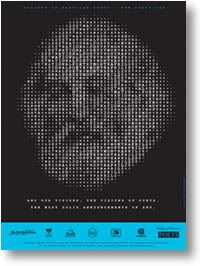
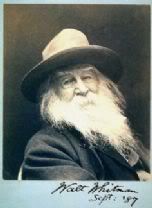
I am posting this a day early since our schedule tomorrow is off, and I am afraid I will forget to post this because I'll be all discombobulated (I love that word). Walt Whitman it the "poster poet" for this year's Poetry Month, so I thought that one of his poems should be my next choice. This past summer, we spent a day in Washington, DC to attend the 2006 Smithsonian Folklife Festival. We made sure to schedule time into our day so we could make a side-trip to the National Portrait Gallery to see their exhibit One Life: Walt Whitman, a kosmos. The collection included excerpts of Whitman's poetry (scattered throughout), a first printing of Leaves of Grass, Whitman's walking stick, and photos spanning Whitman's life. By far, my favorite part of the exhibit was this photograph (right). It captures the joy, commonality, intellect, and exceptionality of Whitman. It turns out that this was Whitman's favorite photograph of himself. He called it "the Laughing Philosopher" and sent a copy of it to Alfred Lord Tennyson (then poet laureate of England). It is the perfect title.

As homeschoolers, we often find ourselves trying to mimic the government schools so as not to appear "weird" or "unprofessional" or to make ourselves appear like a "real school". Although we have to keep our children's educations on track and make sure that they are receiving an excellent education (which often involves textbooks and schedules), we need to remember that one of the gifts of homeschooling is the flexibility to reveal and dissect the flesh of the subjects behind the textbook pages. Whitman's poem, When I Heard the Learn'd Astronomer, caught my attention because it captures the beauty of learning through the ultimate of primary sources. There are some things that cannot be learned in books. They must be experienced in the soul.


When I Heard the Learn'd Astonomer
by Walt Whitman

When I heard the learn'd astronomer;
When the proofs, the figures, were ranged in columns before me;
When I was shown the charts and the diagrams, to add, divide, and measure them;
When I, sitting, heard the astronomer, where he lectured with much applause in the lecture room,
How soon, unaccountable, I became tired and sick;
Till rising and gliding out, I wander'd off by myself,
In the mystical moist night-air, and from time to time,
Look'd up in perfect silence at the stars.

Poem - Forgetfulness by Billy Collins

If you have never read the poetry of Billy Collins, I highly recommend it. I have found it to be highly evocative of emotion, thought, scent, feel, taste... evocative of experience, of life. I will post more of his poetry throughout the month.

The following poem, Forgetfulness, brings you to a point of realizing that there is something you have forgotten, but you can't quite put your finger on what it could be even though you can almost taste it, it's so close. It also allows me a small glimpse into the mind of my grandmother who is suffering from Alzheimer's. That sense of frustration that you know you know something, but you also know that you've forgotten it and can do nothing to get it back. It must choose to return on its own, and the fear that it may choose to never return.

The poem is read by the author and beautifully animated by Julian Grey of Head Gear Animation.

Forgetfulness by Billy Collins


Sunday, April 01, 2007

April is National Poetry Month

To celebrate, I am going to (try to remember to) post a poem every other day. (I am actually going to try to remember to do so every day, but I am not as familiar with poetry as I would like to be, so I won't over-promise).

To start off the month, I am going to share a poem that I wrote last summer. Try your hand at writing a poem and please don't forget to share it. This is the perfect time to try!


It Is So

The Child stands, spies a stick
He stoops, "You shall be my sword."
And it is so.
The Child looks, observes the air
He commands, "You shall be my enemy."
And it is so.
The battle begins, creature against creator
The victor is no mystery, still the battle must be fought
There is honor in it.
Armageddon, the fates of worlds
The creator triumphs, "I am the hero."
And it is so.

Wednesday, September 06, 2006

Poetic Procrastination

Along with the other members of The Great Books Reading Partnership, I am reading Chapter 9 (History Refracted: The Poets and Thier Poetry) of The Well-Educated Mind by Susan Wise Bauer. However, I am finding the section on the history of poetry very difficult to get through because of an anology Ms. Bauer uses that makes the topic more, rather than less, confusing for me.

Anyway, I decided to take a break from reading in the hopes of clearing my head and starting anew after the kids went to bed. I went out to the back porch to watch the kids play outside and to watch the beautiful flights of the brown bats that hunt bugs in our backyard. As I was watching Terzo pick up a stick to fight an enemy I could not see, a poem formed in my mind. Although I like to read poetry, all my attempts at writing it are very juvenile and uninspired. I am generally too concrete and to-the-point in my thinking... i.e. not poetic. This time, however, I wrote the poem down and read it to Frodo... and he liked it. So here it is... such as it is.

It is so

The Child stands, spies a stick

He stoops, “You shall be my sword.”

And it is so.

The Child looks, observes the air

He commands, “You shall be my enemy.”

And it is so.

The battle begins, creature against creator

The victor is no mystery, still the battle must be fought

There is honor in it.

Armageddon, the fates of worlds

The creator triumphs, “I am the hero.”

And it is so.

Monday, May 15, 2006

Can this line ever be drawn?

I read The Well-Educated Mind: A Guide to the Classical Education You Never Had over a year ago. I went out and bought the first two books in the History reading list and the first book in the Fiction reading list, and finally began reading Herodotus' Histories a few months ago. I was really enjoying it, but about two weeks into reading, I essentially gave up. (I still pick it up periodically, but I am not engaging the book as I once was.)

I have a few reasons (excuses) for giving up:

1. I have 4 children that I homeschool. Finding a time that is consistent and sufficient in length and a place that is quiet where my book won't "wander off" when I set it down is very difficult to find.

2. The very thought of reading ancient history as written by an ancient author is extremely overwhelming and intimidating.

3. Since I had no outside accountability, I lost the impetus to keep going as soon as I hit a difficult passage since I had no one to talk through it with.

but the main reason:

4. I cannot make myself write in a book.

Both Susan Wise Bauer (the author of The Well-Educated Mind) and Mortimer Adler (the author of How to Read a Book - which I am presently reading as part of an online book club) recommend writing in books. There are many reasons that they suggest getting into this habit... from noting passages that you have difficulty understanding to simply noting your half of the "conversation" that you are having with the author. I completely understand why readers participate in this practice and it makes perfect sense to me to make notes in the books as I read rather than keep a seperate journal that may get lost or requires me to abandon the asthetic of and engagement with the book to make notes. I just have a very difficult time doing it.

I went to government schools where I was absolutley forbidden to write in a book. I also borrowed many, many library books as a child (still do), and again it was taboo to write in a book. I would never have considered writing in one of my own books as a child... although it is not really necessary to write in the margins of a Curious George or a Nancy Drew book. When I got to college, I did highlight some of my text books, but if I wanted to take notes, I would keep them in a seperate notebook. The first book I ever wrote notes is was my copy of Darwin's Origin of Species. That was last year. I have read the book before, but this was the first time I really studied it. I got halfway through the book, and when I stopped to look back at all my notes and underlining, I thought, "What am I doing?!" I haven't picked it up since.

I have gotten books out of the library where someone has written a note in the margin or underlined something, and it made me angry that someone took it upon themselves to taint the book with thier own thoughts. I was not allowed the gift of experinencing the book in its virgin form and formulating my own thoughts. My reading and understanding of the book would be forever skewed by that tiny note or faint line.

But those are library books. I am not talking about writing in a library book. I am talking about writing in a book that I own. Why can't I write in a book that is mine to do with as I please? When I know that engaging the book my puring over it and taking notes would increase my understanding of it?

Two reasons come to mind. First of all, I am just not in the habit of writing in my books. This is something that can be slowly overcome by just starting to make notes in books as I read. The second reason is that I frequently lend books to family and friends, so I don't want to taint their reading of the book. Granted, I am probably not going to take notes in a Stephen King book which I am much nore likely to lend out than my copy of Herodotus' Histories, but many of the books I do take notes in, I expect my children to read some day. I don't want to rob them of the joy of having their own conversation with Shakespeare or Herodotus or Cervantes.

All this debating and justifying is not going to get me any closer to being able to write in my books. I guess I just need to sharpen my pencil and find a cozy corner and start reading and conversing with my books. And as the children get older, I will continue what I am already doing, give my children thier own copies of books so that they can join in the Great Conversation.

Poet Laureate Billy Collins has a wonderful poem about writing in books entitled Marginalia:


Sometimes the notes are ferocious,
skirmishes against the author
raging along the borders of every page
in tiny black script.
If I could just get my hands on you,
Kierkegaard, or Conor Cruise O'Brien,
they seem to say,
I would bolt the door and beat some logic into your head.

Other comments are more offhand, dismissive -
"Nonsense." "Please!" "HA!!" -
that kind of thing.
I remember once looking up from my reading,
my thumb as a bookmark,
trying to imagine what the person must look like
why wrote "Don't be a ninny"
alongside a paragraph in The Life of Emily Dickinson.

Students are more modest
needing to leave only their splayed footprints
along the shore of the page.
One scrawls "Metaphor" next to a stanza of Eliot's.
Another notes the presence of "Irony"
fifty times outside the paragraphs of A Modest Proposal.

Or they are fans who cheer from the empty bleachers,
Hands cupped around their mouths.
"Absolutely," they shout
to Duns Scotus and James Baldwin.
"Yes." "Bull's-eye." "My man!"
Check marks, asterisks, and exclamation points
rain down along the sidelines.

And if you have managed to graduate from college
without ever having written "Man vs. Nature"
in a margin, perhaps now
is the time to take one step forward.

We have all seized the white perimeter as our own
and reached for a pen if only to show
we did not just laze in an armchair turning pages;
we pressed a thought into the wayside,
planted an impression along the verge.

Even Irish monks in their cold scriptoria
jotted along the borders of the Gospels
brief asides about the pains of copying,
a bird signing near their window,
or the sunlight that illuminated their page-
anonymous men catching a ride into the future
on a vessel more lasting than themselves.

And you have not read Joshua Reynolds,
they say, until you have read him
enwreathed with Blake's furious scribbling.

Yet the one I think of most often,
the one that dangles from me like a locket,
was written in the copy of Catcher in the Rye
I borrowed from the local library
one slow, hot summer.
I was just beginning high school then,
reading books on a davenport in my parents' living room,
and I cannot tell you
how vastly my loneliness was deepened,
how poignant and amplified the world before me seemed,
when I found on one page

A few greasy looking smears
and next to them, written in soft pencil-
by a beautiful girl, I could tell,
whom I would never meet-
"Pardon the egg salad stains, but I'm in love."

Per ClassicalMamma's request, here is the link to my brief notes on Chapter One of HTRAB.