Rubbing alcohol gets melted, red crayon off of tan car upholstery.
Bonus tip: Do not take home the free mini-box of crayons that you get at most restaurants... especially if your kids have trouble remembering to take them out of the car.
Rubbing alcohol gets melted, red crayon off of tan car upholstery.
Bonus tip: Do not take home the free mini-box of crayons that you get at most restaurants... especially if your kids have trouble remembering to take them out of the car.
As parents, we give and receive this advice quite frequently.
When should I introduce solid food? When your baby starts reaching for your green beans or chicken, he's ready to try some. He'll tell you when he's ready.
When should I start potty training? When your toddler starts showing interest in the potty, it's time to sit her on it. She'll tell you when she's ready.
When should I teach my child to read? When you child grabs a book and starts pretending to read, he's ready to learn. He'll tell you when he's ready.
When should I teach my child the birds and the bees? When your child starts to ask questions about where babies come from, she's ready to hear an "age appropriate" answer. She'll tell you when she's ready.
"They'll tell you when they're ready. "
What does this mean?
When we give this advice to another parent, we are generally trying to encourage them not to worry. We are encouraging the parent to wait until the child gives some sort of signal... grabbing the fork, sitting on the kiddy potty, pretending to read a book, or asking if he was in Mommy's tummy just like baby sister. But does this advice work for everything? Let's face it, if many of us waited for our children to tell us they were ready for vegetables or ready to learn to clean their rooms, we'd still be waiting for the signal when they left for college! On the other hand, sometimes we get signals we aren't sure what to do with, are intimidated by, or seem to be "age inappropriate." By age inappropriate, I mean that our child is asking questions about things that our culture has decided are above their comprehension for thier age so we have no guideline for discussing these topics with our children. This seems to happen most often with topics of spiritual signifigance. When do you start talking to your children about topics like sin, redemption, death, and sanctification?
I believe in this situation, where a child is asking a question about a topic you feel he is too young to understand, you answer the question... or at least try to. Lest you respond, "That's easy for her to say." Here are some questions that our kids have asked Frodo and I recently (after each question, I have indicated which child asked it and how old he/ she is):
"Why did God create light first?" (Terzo, 5)
"What would happen if lightening hit our car and we all died?" (Terzo, 5)
"Why would someone steal a kid?" (Primo, 9)
"Why did God make butterflies if they only live for 2 weeks?" (Secondo, 7)
"Why did the Stone Table break after Aslan came alive again?" (Primo, 9)
"Why does God let tornados kill people?" (Primo, 9)
"How come there aren't any more dinosaurs?" (Secondo, 7)
"How come different books about dinosaurs say different things about why they died and what they looked like?" (Secondo, 7)
"How come Eve ate the fruit of the Tree of Knowledge of Good and Evil when God told her not to?" (Terzo, age 5)
"Will you die?" (Primo, 9; Secondo, 7; Terzo, 5)
"Will I die?" (Primo, 9; Secondo, 7; Terzo, 5)
We did our best to answer their questions and pray for wisdom in answering those that will inevitably come up in the future.
Our children will let us know when they are ready to face some of life's hard questions. But I have learned some things through my children's questions... I don't know all of the answers, I probably never will, and I don't ask enough questions myself but it is important that I ask. Asking questions and searching for answers (sometimes receiving them and sometimes not) matures us. If I stop questioning, I stop growing.
Have I stopped asking?
Have you stopped asking?
Does this mean we are not ready for the answers?
Or does it just mean that we are hiding from the responsibility required of us when our questions are answered?
I am sitting here watching the eleven o'clock news on my local ABC affiliate where they just concluded a story on the response of local churches to this weekend's opening of The DaVinci Code. The back and forth debate over this movie has already gotten old, so none of that even phases me now. However, I am realing over this comment made by the reporter at the conclusion of her story:
"Pastors don't get the chance to talk much about theology from the pulpit, but this movie is giving them that opportunity."
WHAT?!??!?!?!
I'm not even sure how to respond to that. Maybe someone needs to buy this woman a dictionary. The most basic definition of theology is the study of God or religion. What does this woman think goes on in churches? She just interviewed a pastor and parishoners who used the words God, church, religion, Christianity, and Jesus repeatedly. Does she really think that these people only brought these topics up because of a MOVIE?!
On the other hand... what if there is more truth in her comment than churches are willing to acknowledge?
What if?
I read The Well-Educated Mind: A Guide to the Classical Education You Never Had over a year ago. I went out and bought the first two books in the History reading list and the first book in the Fiction reading list, and finally began reading Herodotus' Histories a few months ago. I was really enjoying it, but about two weeks into reading, I essentially gave up. (I still pick it up periodically, but I am not engaging the book as I once was.)
I have a few reasons (excuses) for giving up:
1. I have 4 children that I homeschool. Finding a time that is consistent and sufficient in length and a place that is quiet where my book won't "wander off" when I set it down is very difficult to find.
2. The very thought of reading ancient history as written by an ancient author is extremely overwhelming and intimidating.
3. Since I had no outside accountability, I lost the impetus to keep going as soon as I hit a difficult passage since I had no one to talk through it with.
but the main reason:
4. I cannot make myself write in a book.
Both Susan Wise Bauer (the author of The Well-Educated Mind) and Mortimer Adler (the author of How to Read a Book - which I am presently reading as part of an online book club) recommend writing in books. There are many reasons that they suggest getting into this habit... from noting passages that you have difficulty understanding to simply noting your half of the "conversation" that you are having with the author. I completely understand why readers participate in this practice and it makes perfect sense to me to make notes in the books as I read rather than keep a seperate journal that may get lost or requires me to abandon the asthetic of and engagement with the book to make notes. I just have a very difficult time doing it.
I went to government schools where I was absolutley forbidden to write in a book. I also borrowed many, many library books as a child (still do), and again it was taboo to write in a book. I would never have considered writing in one of my own books as a child... although it is not really necessary to write in the margins of a Curious George or a Nancy Drew book. When I got to college, I did highlight some of my text books, but if I wanted to take notes, I would keep them in a seperate notebook. The first book I ever wrote notes is was my copy of Darwin's Origin of Species. That was last year. I have read the book before, but this was the first time I really studied it. I got halfway through the book, and when I stopped to look back at all my notes and underlining, I thought, "What am I doing?!" I haven't picked it up since.
I have gotten books out of the library where someone has written a note in the margin or underlined something, and it made me angry that someone took it upon themselves to taint the book with thier own thoughts. I was not allowed the gift of experinencing the book in its virgin form and formulating my own thoughts. My reading and understanding of the book would be forever skewed by that tiny note or faint line.
But those are library books. I am not talking about writing in a library book. I am talking about writing in a book that I own. Why can't I write in a book that is mine to do with as I please? When I know that engaging the book my puring over it and taking notes would increase my understanding of it?
Two reasons come to mind. First of all, I am just not in the habit of writing in my books. This is something that can be slowly overcome by just starting to make notes in books as I read. The second reason is that I frequently lend books to family and friends, so I don't want to taint their reading of the book. Granted, I am probably not going to take notes in a Stephen King book which I am much nore likely to lend out than my copy of Herodotus' Histories, but many of the books I do take notes in, I expect my children to read some day. I don't want to rob them of the joy of having their own conversation with Shakespeare or Herodotus or Cervantes.
All this debating and justifying is not going to get me any closer to being able to write in my books. I guess I just need to sharpen my pencil and find a cozy corner and start reading and conversing with my books. And as the children get older, I will continue what I am already doing, give my children thier own copies of books so that they can join in the Great Conversation.
Poet Laureate Billy Collins has a wonderful poem about writing in books entitled Marginalia:
| Sometimes the notes are ferocious, skirmishes against the author raging along the borders of every page in tiny black script. If I could just get my hands on you, Kierkegaard, or Conor Cruise O'Brien, they seem to say, I would bolt the door and beat some logic into your head. Other comments are more offhand, dismissive - "Nonsense." "Please!" "HA!!" - that kind of thing. I remember once looking up from my reading, my thumb as a bookmark, trying to imagine what the person must look like why wrote "Don't be a ninny" alongside a paragraph in The Life of Emily Dickinson. Students are more modest needing to leave only their splayed footprints along the shore of the page. One scrawls "Metaphor" next to a stanza of Eliot's. Another notes the presence of "Irony" fifty times outside the paragraphs of A Modest Proposal. Or they are fans who cheer from the empty bleachers, Hands cupped around their mouths. "Absolutely," they shout to Duns Scotus and James Baldwin. "Yes." "Bull's-eye." "My man!" Check marks, asterisks, and exclamation points rain down along the sidelines. And if you have managed to graduate from college without ever having written "Man vs. Nature" in a margin, perhaps now is the time to take one step forward. We have all seized the white perimeter as our own and reached for a pen if only to show we did not just laze in an armchair turning pages; we pressed a thought into the wayside, planted an impression along the verge. Even Irish monks in their cold scriptoria jotted along the borders of the Gospels brief asides about the pains of copying, a bird signing near their window, or the sunlight that illuminated their page- anonymous men catching a ride into the future on a vessel more lasting than themselves. And you have not read Joshua Reynolds, they say, until you have read him enwreathed with Blake's furious scribbling. Yet the one I think of most often, the one that dangles from me like a locket, was written in the copy of Catcher in the Rye I borrowed from the local library one slow, hot summer. I was just beginning high school then, reading books on a davenport in my parents' living room, and I cannot tell you how vastly my loneliness was deepened, how poignant and amplified the world before me seemed, when I found on one page A few greasy looking smears and next to them, written in soft pencil- by a beautiful girl, I could tell, whom I would never meet- "Pardon the egg salad stains, but I'm in love." |
Per ClassicalMamma's request, here is the link to my brief notes on Chapter One of HTRAB.
I had been attempting to avoid this topic, and succeeded until I went onto the Well Trained Mind message board today and found that my only oasis from this topic had finally been tainted by it, and I realized, for my own sake, I had to say something... then I will let it go.
For those of you who may not be familiar, there has been a controversy for years over two parenting books: To Train Up a Child and On Becoming Babywise. The first discusses discipline issues and the second breastfeeding issues. The issue came to a head recently when a couple applied a discipline proceedure not mentioned in the TCUAC book and killed thier son. Later, the couple mentioned TCUAC as thier primary resource on discipline (techniques which they took too far), so the book got labelled as the manual of child abusers.
So that I am being upfront and honest with everyone, I happen to own both books in question (actually I lent one to someone and never got it back, but that's irrelevant.) I read both many times, lent them to people, applied some of the principles of both books, and ignored some princilples in both books.
I very rarely agree with everything in every book I read, and there are many that I don't agree with much at all. If I own it and don't want it any more, I may donate it to the library, freecyle it, give it to a friend, toss it or burn it in the burn barrel depending on the book (keeping in mind content and condition). I do not view any book (with the exception of the Scriptures because I am a Chirstian) as sacred. If you are a private citizen and want to burn your copy of a book, go ahead. I tend to be environmentally concious, so that comes to play in my decision on what to do with a book I no longer want. I am amazed at the calls for the mass banning and burning of these books and anyone who has any association with them (including Homeschol Blogger because the magazine the site's owners publish has advertized the books.)
I don't expect everyone to agree with every author's recommendations in books (like the ones I mentioned above or any other book). Some people take things too far in their applications and some people don't go far enough. Some people have mis-applied Scripture, abused the Constitution, and used kitchen knives to murder people rather than to butter their bread, but I do not think these things need to be banned or burned for censorship's sake. Should we have the right to get rid of books (or anything else) in our possession that we do not find edifying and supportive of our mission to "glorify God and enjoy Hin forever?" Yes. As Americans we have the right to do that and more, but I don't beleive that this is the true issue here. The true issues here are the lack of recognition of sin and the abuse of autonomy that causes people to think of themselves as better than others.
Sadly, we live in an imperfect world. We will never get rid of abuse, neglect, murder, and hatefulness. Should we strive to overcome these things? Yes. But we must also trust God, have good-faith in our neighbors, and invest ourselves in each others lives so that when someone wants to go too far in their application of something (like beating their child to death with plumbing supplies) we can step up before (with love and familiarity) and say "No!" rather than wait until afterwards to feed our self-rightousness (I include myself in this) and say "I would never do that!" and try to find blame. The real crime here is one of selfishness and laziness on the part of those of us just outside these situations.
We need to regain the desire and ability to talk to our neighbors and friends openly and intimately about topics that are controversial, get our opinions out there, and trust that others can use their brains as well as we use our own and make their decisions thoughtfully. It is just as much my fault as anyone's that it happened because I didn't love my neighbor enough to stop them before-hand because it was politically incorrect to do so. When my parents were little, it was common that if a neghbor saw them doing something wrong, the neighbor would go out and stop them then go talk to thier parents. That rarely happens any more... with children or adults. We have taken independence and autonomy too far. We silently recognize this fact and attempt to reconcile it by having the government do the dirty work for us. See a child with a dirty face or a bruise? We call Child Protective Services annonymously. We would feel too "weird" doing it ourselves. Have we stopped to think that we should feel weird? We feel awkward because deep down we know that we are just as sinful and in need of rebuke. We know that "there but by the Grace of God go I." We ask ourselves, "Who am I to confront them about their sin? I'm not perfect either." Of course you aren't. No one is. But we are afraid that if we point it out in someone else they might point it out in us, and we will shatter the visage that we have worked so hard to create.
We have to confront sin, in ourselves and others, not because we are perfect but because God is. We have to acknowledge that our world is perverted. Man was not meant to live in a world pervaded by sin and death. We were created for Eden and to be in intimate fellowship with God. Will pointing out our own and others' sin return us to Eden? No. But we can't get to where we were intended to be if we don't first acknowledge that we are lost.
Now, I will let it go.
(By the way, I am leaving this open for comments, as I do all my posts, under the assumption that you will comment civily and respectfully. I will delete or edit comments that do not meet this criteria. Thank you.)
Disappointment #1:Crunchy Cons
I recently mentioned that I was looking forward to (to put it mildly... see Literary Euphoria) reading this book. I was so disappointed with Crunchy Cons that I’m not going to expend the energy to type its lengthy subtitle. In short, the book’s author, Rod Dreher, claims to expand on his revelation of a new movement within political conservatism (and more specifically the Republican Party) that is trying to “[reclaim] what’s best in conservatism”, namely “the permanent things” – faith, family, community, and legacy. Instead, Dreher spends his time repeatedly stating that he desires to see conservatives return to their small-government, faith-based, family-centered foundation by using the government to reign-in big business, put controls on the free market, provide tax-breaks and other policies that encourage the growth of small businesses (especially if they are family-owned, organic farms), use zoning laws to encourage the preservation of historic buildings and prevent suburban sprawl, encourage the development of alternate energy sources, encourage the expansion of private civil organizations (like churches and charities), and care for the poor. The book oozes with these inconsistencies of philosophy and proposed action. By the end of the second chapter, I was vainly hoping that he would remove his Guy Fawkes mask and reveal that it was really Joe Lieberman underneath. This book just reinforced to me that nowadays there is no practical difference between the two major American parties and that the terms “conservative” and “liberal” have become meaningless except at their most radical.
Disappointment #2: Crash
I had wanted to see this movie since I saw the first trailers for it. Being the frugal people that we are, we were waiting for it to come onto DVD then to the library before we saw it. However, the videophiles in us are stronger than the penny-pinchers, so as soon as it won the Academy Award for best picture, we went out and bought it. I had heard such great things about this movie, and I thought it was a great concept, but I was thoroughly disappointed. Many of the situations seemed forced, and the dialogue frequently seemed unnatural to the character to whom it was assigned. The screenwriter boldly used the device of pulling you down what seemed a stereotypical story path only to yank you into an emotionally charged, unexpected denouement. This would have been an excellent technique to reinforce the movie’s theme of shattering stereotypes had the writer not gone to this well so often that I felt like Mickey Mouse in Fantasia with no wizard to clean up the mess that had been made. The rare gems in this movie (Sandra Bullock’s performance was a pleasant surprise, and I always enjoy watching Don Cheadle) are not worth the almost 2 hours. The tagline for Crash is “You think you know who you are. You have no idea.” There are three movies that better explore this concept:
The Gem: The Man Born Blind
I have already admitted to having literary-ADD. This constant switching back and forth between books can have its setbacks… for example, I was looking for one of only a handful of good quotes from Crunchy Cons to read to Frodo the other night and realized, long after Frodo gave up waiting for me to find it, that the quote I wanted was in the Thomas Sowell book, Inside American Education, that I am also reading. (At least that more logically explains why I thought it was a good quote!) However, sometimes literary-ADD can lead me to a wonderful work of literature that I otherwise would not have found. I have read a goodly amount of C.S. Lewis’ fiction, but it was the Stephen King series that I am presently in the midst of that led me to the C.S. Lewis short story entitled The Man Born Blind. In the preface to the short story collection, The Dark Tower and Other Stories (fans of Stephen King just went “Ah ha!”), editor Walter Hooper describes the story as being about a man born with double, congenital cataracts who has his sight restored and then goes on a quest to learn what light is. I guess that is the best way to describe this story, but it seems so desperately insufficient that it is almost painful. I rarely cry when I read, but when I read this aloud to Frodo last Sunday, I had to stop to compose myself in order to finish the story… then broke down immediately upon concluding it. Read this story. Then ask yourself, “What is Light?”
Mental Multivitamin had this activity posted, so Frodo and I decided to complete it. Frodo has read way more of these books than I have (but then again, he was an English major and I was a Bio major). Here is my list:
Review the following list of books. Boldface the books you've read, italicize those you might read, cross out the ones you won’t, put an asterisk beside the ones on your bookshelves, and place brackets around the ones you’ve never even heard of.
The Da Vinci Code (Dan Brown)
The Catcher in the Rye (J.D. Salinger)
* The Hitchhiker's Guide to the Galaxy (Douglas Adams)
* The Great Gatsby (F. Scott Fitzgerald)
* To Kill a Mockingbird (Harper Lee)
The Time Traveler’s Wife (Audrey Niffenegger)
[His Dark Materials (Philip Pullman)]
Harry Potter and the Half-Blood Prince (J. K. Rowling)
* The Life of Pi (Yann Martel)
* Animal Farm: A Fairy Story (George Orwell)
* Catch 22 (Joseph Heller)
* The Hobbit (J.R.R. Tolkien)
[The Curious Incident of the Dog in the Night-time (Mark Haddon)]
* Lord of the Flies (William Golding)
* Pride and Prejudice (Jane Austen)
* 1984 (George Orwell)
Harry Potter and the Prisoner of Azkaban (J. K. Rowling)
* One Hundred Years of Solitude (Gabriel Garcia Marquez)
Memoirs of a Geisha (Arthur Golden)
[The Kite Runner (Khaled Hosseini)]
The Lovely Bones (Alice Sebold)
* Slaughterhouse Five (Kurt Vonnegut)
[The Secret History (Donna Tartt)]
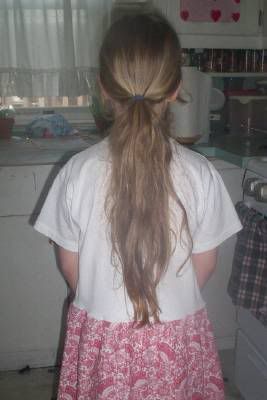
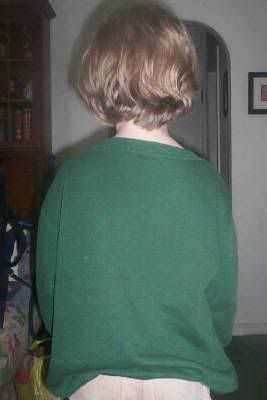
For those of you not familiar with this organization, Locks of Love is a non-profit organization that collects hair from donors and has it made into individualized wigs for children suffering from conditions or treatments that cause them to lose their hair. Those of you who know Primo know that she has very long hair... or at least she did. Thursday morning, Primo donated 10 inches of her hair to Locks of Love. Although her haircut turned out a little shorter than she was expecting, she felt much better that some little girl with no hair would now have a short haircut like hers and be very appreciative of it. The salon where Primo had her haircut was wonderful. (We had never been there before. You have to donate at an approved salon where the stylists have been trained in how to collect the hair.) The salon gave Primo a free cut and style and sent her a thank you note for donating her hair.
If you or your daughters have long hair (donated hair needs to be at least 10 inches long) and are looking to get a shorter haircut for the summer, please go to the Locks of Love website (linked above) and find an approved salon near you through which you can donate your hair rather than having it swept into the trash. There is a child out there who would love your unwanted hair.
I'll post this a little early. (Responses encouraged!)
He Is Risen!
Because this book is written for the general public, it does not feature long, convoluted sentences with escape clauses designed to prevent words from being twisted to mean something that they were never intended to mean. Common sense can be more readily expected when writing for the general public than when writing for the intelligentsia.
- Thomas Sowell
Preface to Black Rednecks and White Libe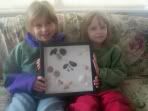
We finally sat down and identified and mounted the shells we collected at the beach last summer. I wish I could say that we planned to wait this long... to allow us to relive our summer fun while working on this project, but that would be lying (although we did have a great time talking about all the great things we did that week). In any case, now it is done, and it looks great! Great job girls!
Stepping Heavenward has reprinted a wonderful post from the Well-Trained Mind Message Boards. I may need to print this out so that I can re-read it every day. Thank you 'Tracy in Ky' for laying this out so eloquently.
For literary-ADD suffering, bibliophiles like me, there is nothing better than when the library calls and tells you that the book you have been waiting for is ready to be picked up.... well, there's one thing. Buying a new book that you get to keep for your very own. Today, I experienced both.
Over a month ago, I put the newest Thomas Sowell book (Black Rednecks and White Liberals) on hold at the library. My heart sank when I discovered that I was third in queue. (When I discover the existence of a new book that I want to read, I want to read it now. Apparently, there are at least two other people in our library system that feel the same way. ) Today, Wednesday is "library day", I went online to renew library books and see what had to go back so I could make a list of books, movies, audio books, and music for the kids to collect and put into the library bag. (This is a much-anticipated, inexpensive, weekly game in our home!) And there it was in black and white... it was ready. I could hardly wait to get to the library.
Back to yesterday, where, after donning my Berkenstocks that I had just rescued from winter storage, I sat down to check out another homeschool blog, Stepping Heavenward. There I read part one of her review of a new book out called Crunchy Cons: How Berkenstocked Burkeans, gun-loving organic gardeners, evangelical free-range farmers, hip homeschooling mamas, right-wing nature lovers, and their diverse tribe of countercultural conservatives plan to save America (or at least the Republican Party). How could I not read this book?! I started to order it from Amazon.com, but I couldn't wait a whole week, and since I was going out to Wally World later that night anyway, I figured I could pick it up there... they didn't have it. So, on the way to the library today, I realize that I have to pick up a baby gift for the couple I teach natural childbirth classes to (really... how could I not read this book?!), and decided that a book would be a good gift. And while I was there, I could just see if they had a copy of Crunchy Cons in stock. They did!
Thus.... literary euphoria! I now have two great (new) books to read (not to mention the stack of books I am in the midst of reading). Now, which to read first...
I'll decide after wrapping the baby books I got.... and taking the stickers off the copies I bought for Quarto. You gotta start 'em young!
Human Events Online has an interesting article, and accompanying graph, showing each state's (and the District of Columbia's) per pupil spending for government school students and the percentage of eigth-grade students reading and doing math computations at grade level. NONE of the 50 states or the District of Columbia had more than 44% of its eigth graders reading or doing math computations at grade level! This is unacceptable!
What is even more unacceptable is that I have to turn over a portfolio of my third-grader's work to a local government school official who will decide whether or not I am properly educating my homeschooled child! I understand that all school districts are different, and that the percentages presented in the aforementioned article include students in districts where many negative factors influence thier school performance (or lack thereof). Our school district only spends about $4300 per student (about half the state average), and actually scored much better than the state averages at 63% math and 64% reading (state levels were about 1/3 proficient at math and reading).
In contrast to the government schools, our homeschool budget last year was about $500. That works out to $166.67 per student (one pre-K, one 2nd grader, and one 3rd grader), and 100% of our school's students are reading and doing math computations at or above grade level!
Just something to think about.
1. I can "read" a book in the car without vomiting.
2. My kids can hear a book in the car without also hearing vomiting (Frodo usually drives, so I would be the one left to do the reading).
3. Having kids experience great books that are above their reading level, but not above their ability to comprehend.
4. Better than an in-car DVD. I know this can be controversial, but I much prefer audio books to movies in the car because we all get to hear books we might not normally pick up to read (for example, my kids heard The Perfect Storm a couple of years ago, and we grownups heard one of the best books ever written, The Tale of Despereaux). Plus, I can listen to great "children's" literature and say, "Well, I was only putting it on for the kids." (Although no one will believe me now, since admitting that The Tale of Despereaux is one of my favorite books.) Also, watching a movie is passive, but listening to a book exercies the imagination. And besides, have you ever tried to put an in-car DVD system in a Taurus?!
5. Entertainment. I have rarely enjoyed myself more than the time spent listening to Tim Curry read the Series of Unfortunate Events books.
6. Education... I am learning a great deal about the Greeks and Greek history (more than I ever learned in school) by listening to Sailing the Wine-Dark Sea. Also, the kids must ask me dozens of times what different words and turns of phrase mean while we are listening to books.
7. Unexpected entertainment. Yesterday, we were listening to an Arthur audio book in which Arthur is playing on a baseball team for the first time. During Arthur's first game, Arthur is in the outfield dreading having the ball come in his direction. "The pitcher throws the first pitch, and it's a ball." Primo immediately pipes up, "Of course it's a ball! What is it supposed to be?! A hockey puck?!" (Which brings us back to point 6 in which Primo received a lesson on the rules of baseball.)
A note: Although my above list implies that we listen to audio books only on long car trips, this is most certainly far from accurate. We listen to audio books almost constatly when we are in the car... running errands, going to church, going to a friend's house. We always keep an audio book with us in the car. We will listen to music on occasion (and rarely the radio), but we LOVE our books!
It was the possibility of darkness that made the day seem so bright.
-Dark Tower V: Wolves of the Calla
Last year, the girls participated in a homeschool book club at our local library. The group had about 10 kids on a regular basis, and they read some really good books and enjoyed the company of their friends. This year, the girls couldn't wait for the book club to start again, so as soon as I could, I signed them up.
The club started out fairly strong but has quickly dwindled to 2 children... Primo and Secondo. Mrs. B, the librarian in charge, asked me to put the word out about the club or she would have to discontinue it... it's a lot of work for only 2 kids who are in the same homeschool. I did... and now we have 3. But I am not sure how long that will last.
The last book the kids were required to read was any book in the Mrs. Piggle- Wiggle series. Not terribly difficult books, but funny stories that were good for kids of various reading levels (the book club is for grades 1-3). In order to attract more kids, Mrs. B decided to choose easier, faster reads. This month's book is A Ghost Named Fred. Unfortunately, the library only has 4 copies of this book, and all of them were checked out. The girls put 2 on hold and hoped they would come in in time to read them for next month's meeting. They needn't have worried.
The girls are required to read for at least 30 minutes per day on their own. They get to choose their own book and often read their book club books at this time. As soon as the books came in, the girls set aside their other reading (Primo - Charlotte's Web, Secondo - Harry Potter and the Sorcerer's Stone) and opened their book club books. Ten minutes later, Primo calls out, "I'm done!" then Secondo follows, "Me too!" I can't believe it, so I ask Primo for her copy of the book so I can skim it and quiz them. I read the entire book in about 2 minutes... this was the first page. I ask them a few questions, then Secondo asks, "Can I read Harry Potter now?" "Absolutely!"
I appreciate everything Mrs. B has done for the girls and the club. The girls adore her. However, I think we will settle for the summer reading club and letting the girls select their own books next year.