Showing posts with label theology. Show all posts

Tuesday, August 26, 2008

Wronger Than Wrong

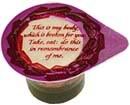
I'm not really sure what to say about this:


Among some of the benefits of their prefilled communion cups, the website lists that the cups are 1) sanitary, 2) less messy, and 3) result in less waste. My thoughts when reading this list of "benefits" were:

1) Less sanitary than the little individual glasses that are run through the dishwasher after every Lord's Supper? Of course, I wasn't taking into account those traditions that use a communal chalice, but then wouldn't those taking part in a communion with a communal chalice loose the "community" part of their communion by switching to individual cups, prefilled or not? I guess it depends on what your priorities
are in taking part in the sacrament.

2) Less messy? Obviously the creators of this haven't attempted to open the orange juice or apple sauce that often come in these little foil-lidded containers. Or maybe it's just me. I always end up with applesauce all over my knuckles when I open those things. I can't imagine that I would be in a very worshipful mood after opening my communion-on-the-go and spilling permanently staining grape juice all over myself... not to mention what that juice is supposed to represent.

3) Less waste? Sure, many churches fill more cups with juice or wine than they think they may need to be on the safe side, but that would amount to what? Maybe a cup of juice would go unused - if that? And many priests in churches that use communal chalices drink the excess juice or wine since it has been blessed and should not just be poured down the drain, anyway. But what about the foil lid and plastic cup that now have to be thrown away? I know that many churches already use little ,disposable plastic cups, and I am not too thrilled with that either. Why not just use washable, glass cups? But that aside, the prefilled cups not only have the plastic juice cup, but they now add a foil lid and a seperate wafer packet. Are they going to put trash cans near the altar in churches where the congregants go forward to recieve communion?

The whole idea of prefilled communion cups just seems so wrong. It moves the idea of the communal sharing of rememberance into the modern fast-food culture. We're the children of God, right? Why not just go all the way and add a Bible hero action figure and call it a Truly-Happy Meal? Our praise choruses already border on being glorified (pardon the pun) jingles, so all we need is a catchy slogan and viola... God's entered the fast food market.

Seeing these cups reminded me of a story I heard on NPR a couple years ago about the comfort and sense of community a listener felt every Sunday as she heard the glass communion cups clink into the pew racks after the congragation finished thier Lord's Supper. I love that sound, too. I can't imagine replacing it with the sound of tin foil being pulled off of plastic juice cups.

To quote Mammy, "It ain't fittin'. It just ain't fittin'."

Saturday, June 07, 2008

Little Serendipities Go A Long Way

I am a planner by nature. If I find out that we are traveling somewhere (and it doesn't have to be far; if we are going to be away from home for more than a couple of hours, that's enough) or having company, out come the paper and pencil, I pull up MapQuest and Google on the computer, and the research and planning begin. And although I get great pleasure out of planning little (and big) excursions, it is often those little serendipities that provide the most pleasure and the greatest memories. We recently experienced one of these little serendipities, and I know it is something I will always remember.

My parents came to visit a few weeks ago. They had never been to our new place here in Dixie, and since our new home is over 1,000 miles from their place, we haven't seen each other in almost a year. With the price of gas soaring as it is, who knows when we'll get together again, so I decided to try and plan some short trips that would give them a good taste of the area in their short trip plus include some places our family hadn't had a chance to explore yet. One of the places we went was the University Museum. Our family had been there before, but it is quite an impressive little museum. They have a wonderful antiquities collection that includes pottery, coins, mosaics, and busts as well as a doll collection, a Civil War (or should I say "War Between the States" or "War of Northern Aggression") collection, a small but broadly representational art collection, and a collection of historical scientific instruments that my children always find fascinating and wish they could touch. Tucked off on the side is a small room that usually houses a temporary exhibit. Terzo was very disappointed when he investigated back there this time and found that the Art of the Faulkners exhibit that we had seen on our last trip was gone. "Now it's just some old books," he lamented to me. Not connecting his statement with some information Frodo had given me earlier in the semester, I took my time moseying back to the exhibit and stood only feet from it is a I re-examined a sketch created and autographed by Kurt Vonnegut that is part of the museum's regular collection. Frodo was just behind me as I finally made my way to the "old books" and I could hear him gasp as we entered, "These are the Remnant Trust books. Remember, Hon, I told you about these? Cool."

At the beginning of the spring semester, Frodo mentioned that the University was going to host a tour by the Remnant Trust. The tour consisted of books considered significant because of their age, rarity, or influence on the world, but even cooler, you not only got to see the books, but you also got to touch them. When I went to the University Museum's website to see if I could take the kids over to leek at the books, I came across this notice:

These books are available for professors to use in their classes under supervision in the museum. The books cannot be removed from the museum. We can accommodate groups up to 70 in our [gallery], up to 40 in our classroom and up to 10 in our board room. For larger classes special arrangements may be possible. We need two weeks notice to arrange to host your class at the museum. Our regular hours are 9:30-4:30 Tues.-Sat. We will try to accommodate classes that meet outside of those hours when ever possible but we cannot guarantee that. Call... to book a class.

Drat. We weren't going to be able to go. Frodo was hoping to arrange a time for his university students to go to the exhibit, but he wasn't able to get a hold of the correct person to arrange an appointment. With the end of the semester, we figured his chance to view the exhibit had gone.

Fast forward to my parents' visit two weeks after the semester ended. The RT was late in picking up the collection, so the University Museum still had it on display! As we were oohing and aahing over the books in the display cases, a museum employee approached us and asked if we wanted the curator to open the cases for us and give us a closer look at the books. Minutes later, we were getting a personal lesson on the books on display.


This is the curator showing us a handwritten, illuminated manuscript (on parchment, I might add) of the Magna Carta from 1350. 1350!

Then, it got even better:

That's Frodo and Primo holding and casually thumbing through a handwritten, illuminated manuscript of the Magna Carta from 1350. How cool is that?!

Here is a closer view. (Handwritten! 1350! Did I mention that it was handwritten and illuminated on parchment in 1350?)

The curator shared the books in all the display cases then left them open for us to go back and pick up and leaf through the ones we wanted and to ask questions.

What other books were there? Well...

Secondo's favorite was the illuminated copy of St. Augustine's City of God c. 1494 (two short years after "in 1492 Columbus sailed the ocean blue.")


I tried to take a picture of her flipping through it, but every time she suspected she was being watched, she took her hands off the book. See, here she is doing the "Me? I wasn't touching the book. I was just standing here rubbing my eye" move. I think she had "don't touch the exhibits" going through her head no matter how many times we were told to feel free to pick up and examine the books.

A first edition of Thomas Paine's Common Sense... printed in England in 1776.


If you ask Primo which book was her favorite, she will tell you it was this one, Summa Theologica Pars Secunda c. 1497. From the accompanying plaque:
"One of only three known copies in the world. One in the British Museum in London and the other in the Newbury in Chicago. This is the most perfect of the three."


See the large blanks in the copy? This copy was supposed to be illuminated, but apparently no one got around to it.


Although she says Aquinas' book was her favorite, Primo spent most of her time paging through this 1862 copy of William the Conqueror's Doomsday Book.


Terzo's favorite was this print of the Boston Massacre made from the plate created by Paul Revere and his silversmiths. (The curator was impressed that Primo knew that the Boston Massacre was instigated by the children of Patriots, and some Patriots, throwing snowballs at the British soldiers... although something was bound to happen sooner or later after months of military occupation in Boston.)

Frodo had a hard time nailing down a favorite. Besides City of God, the Magna Carta, and Summa Theologica which I have already shared, he probably would list the two works by Frederick Douglass that were included in the display.


Narrative of the Life of Frederick Douglass (1945)


My Bondage & My Freedom (1855) signed by Frederick Douglass

On the top of a list of Frodo's favorites, if he had been forced to rank them, would have been the copy of John Calvin's Institutes printed in 1578. William Shakespeare was apprenticing at the print shop where this edition was printed and probably set some of the type for the volume. Unfortunately, I don't have a picture of the book. I got a picture of the plaque, but not the book. (Mom, do you have a picture of Calvin's Institutes?) Not sure how that happened. I was probably distracted by my favorites in the collection.


William Penn's The Great Case of Liberty of Conscience c. 1670.


I was also amazed to see the Minutes of the Second Continental Congress from 1778 and the Illinois broadside of the Emancipation Proclamation signed by Abraham Lincoln. (Each president signed all broadsides sent to his home state.) I couldn't get a good picture of the broadside because it was framed under glass, and I have no idea why I don't have a picture of the minutes. (Mom? Did you get one?)


Other books in the collection were William Blackstone's Commentaries on the Law, 1771 (above), Mary Wollstonecraft's A Vindication on the Rights of Women, Benjamin Franklin's Pennsylvania Anti-Slavery Document (1787), and Letters Concerning the English Nation (1733) by Voltaire.

What a great day!

Wednesday, April 02, 2008

Church Membership

In order to become members of the Presbyterian Church of America (PCA), as we are, you must affirm five vows:

1. Do you acknowledge yourself to be a sinner in the sight of God, justly deserving his displeasure, and without hope, except through his sovereign mercy?

2. Do you believe in the Lord Jesus Christ as the Son of God, and savior of sinners, and do you receive and trust him alone for salvation as he is offered in the gospel?


3. Do you now resolve and promise, in humble reliance upon the grace of the Holy Spirit, that you will endeavor to live as becomes a follower of Christ?


4. Do you promise to support the church in it's worship and work to the best of your ability?

5. Do you submit yourself to the government and discipline of the church, and promise to strive for its purity and peace?


Primo and Secondo took these vows at our church's Maundy Thursday service. They are the girls in the hats. The pastor with the dark hair is our head pastor. The pastor who looks like Santa Claus is our youth pastor. We love them. The other gentlemen are church elders. (We love them, too.) I think it's funny that when each man hugs Secondo, they act as if they are afraid to break her. *grin*

I apologize in advance for the incompleteness of the videos. This was my second attempt to use the video feature on our camera. (You can imagine how sad the first attempt came out.)


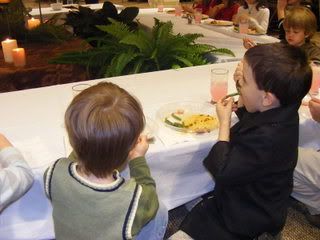
After the service, we enjoyed a delicious ham dinner. The kids loved eating at the Passover Seder table. You can see the girls in their hats in the background. Terzo is the one in the black coat in the foreground. (The coat was new, and he refused to take it off.)


Here are Terzo and Quarto enjoying their supper.


This church really knows how to host a supper!


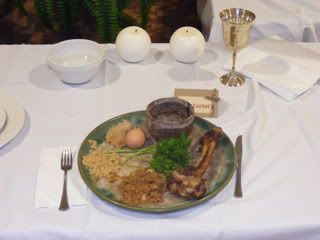
This is the Seder Plate containing chazeret (bitter herbs representing the bitterness of slavery), charoset (sweet, brown, grainy mixture representing the mortar used by the Hebrew slaves in Egypt), karpas (a simple food dipped into salt water, representing tears, to remind us of the plain foods the Hebrews ate while in captivity), z'roa (roasted lamb shank bone representing the Pesach sacrifice now fulfilled by Christ, the Lamb of God), and beitzah (representing the festival sacrifice, or chagigah, and symbolizing mourning).


And lastly, Elijah's place.


Sunday, March 23, 2008

The Hyenas Did Not Touch Him

The Maasai Creed

We believe in the one High God, who out of love created the beautiful world and everything good in it. He created man and wanted man to be happy in the world. God loves the world and every nation and tribe on the earth. We have known this High God in the darkness, and now we know him in the light. God promised in the book of his word, the Bible, that he would save the world and all nations and tribes.

We believe that God made good his promise by sending his son, Jesus Christ, a man in the flesh, a Jew by tribe, born poor in a little village, who left his home and was always on safari doing good, curing people by the power of God, teaching about God and man, showing that the meaning of religion is love. He was rejected by his people, tortured and nailed hands and feet to a cross, and died. He was buried in the grave, but the hyenas did not touch him, and on the third day, he rose from that grave. He ascended to the skies. He is the Lord.

We believe that all our sins are forgiven through him. All who have faith in him must be sorry for their sins, be baptized in the Holy Spirit of God, live the rules of love, and share the bread together in love, to announce the good news to others until Jesus comes again. We are waiting for him. He is alive. He lives. This we believe. Amen.

He is risen!

Wednesday, February 13, 2008

Come, Buy and Eat!

So, it seems we have some money coming our way. The idea behind the related part of the “stimulus package,” in case you haven’t heard, is that we all will take our checks from the government and spend them at our local box store in order to defibrillate our apparently flatlining economy. Many critics of the stimulus package arose as soon as it started winding its way through the halls of power, but its effectiveness is hardly related to my writing fellow followers of Christ throughout our country.

I should stop for a moment to say that the $1,800 or $2,400 or whatever it happens to be that the Federal government seems intent on giving to my family could prove very useful around our home. I am currently a graduate student with a family and, as you might be able to imagine, it would be nice to budget in a little more meat and a little less starch into our diet, or perhaps get an inexpensive used car so that one person’s absence doesn’t bind the rest of the family at home, but other considerations have convinced us to use our share in a way that might seem both impractical and, to some, unpatriotic. Allow me to explain.

Think back to the weeks following September 11, 2001. Do you recall how we were challenged to defeat terror? In case you’ve forgotten, I’ll give you a hint. It didn’t involve humility or sacrifice; instead, we were to fight by continuing to buy and fly. Never mind that encouraging Americans to be good consumers is a bit like encouraging bricks to be hard; I have a feeling we would have gotten back on our spending feet with or without an executive pronouncement. Anyway, at least on a superficial level, the tactic seemed to have averted one potential disaster, so it’s time once again to love our country by loving ourselves.

But isn’t the church supposed to be different? Christ warns us that we cannot serve both God and material things, yet how many of us find ourselves looking a lot more like earnest inhabitants of what Augustine called the “city of man” than like followers of Christ. Some scholars speculate that the writer of Ecclesiastes may have been Solomon, partly on the basis the claim that “I denied myself nothing that my eyes desired.” While such extravagance may have been reserved for the powerful in ancient Israel , very average Americans can daily feed their lusts in astonishing ways – ways that should, but usually don’t, make us blush.

Now that we are once again hearing that being a good American seems to involve shopping or taking a vacation or eating out, Christians have an opportunity to stand in a meaningful way against the spirit of the age. Don’t buy the culture’s arguments about so-called needs and don’t buy stuff with your money this time. Instead, let’s find actual needs and meet those instead. I can’t say where you might find them; as for my family, we will likely direct ours to people for whom poverty is a much harsher reality than we will ever know, even with the specter of a recession haunting our near future.

I firmly believe that God uses physical realities to communicate spiritual truths to us, so that when, for example, the Apostle Paul wrote in II Corinthians of one church’s wealth meeting another’s need, it was a reminder of what a dramatic repudiation of this world’s commercial paradigm a gospel of grace represents. Earlier in the Scriptures, God even addresses Israel using the language of commerce to emphasize just how seismic this shift is:

Come, all you who are thirsty,
come to the waters;
and you who have no money,
come, buy and eat!
Come, buy wine and milk
without money and without cost.

Isaiah 55:1


We all know that the best store was the one where we could afford nothing but walked out with more than we could ever carry. Perhaps that’s a sign that we could hand off one of our bags to someone else. Isn’t that kind of economy much more stimulating anyway?

Sunday, February 10, 2008

Wayward Christian Soldiers by Charles Marsh

I had gone to one of my local Christian bookstores to find a Bible for my goddaughter. On a whim, I also decided to to look for a Holy Spirit lapel pin, the kind that had always been easy to find in the display case in the front. Many people in my church and in the places where I traveled had been wearing the American flag on their lapel for months now. It seemed like a pretty good time for Christians to put the Spirit back on. But the doves were nowhere in sight. In the place near the front where I once would have found them, I was greeted instead by a full assortment of patriotic accessories - "support our troops" ribbons, "God Bless America" gear, and an extraordinary cross and flag bangle with the two images welded together and interlocked. I felt slightly panicked by the new arrangements. I asked the clerk behind the counter where the doves had gone; they had always been so popular in the subculture. The man's response was jarring, "They're in the back with the other discounted items," he said, nodding in that direction.
- page 6


On Friday, February 1st, our family went to hear a reading by author and University of Virginia professor, Charles Marsh. The reading was for his latest book, Wayward Christian Soldiers: Freeing the Gospel from Political Captivity, in which Prof. Marsh attempts to shake the Evangelical Christian body by the shoulders and wake it up to the fact that it has taken the trust, passion and faith it should have reserved exclusively for God and has adulterously given them to the American government instead.

We have become idolaters. Egotistical idolaters. As the American Church, we have looked to ourselves as the standard which God uses to measure truth throughout the world. The more American a foreign populace appears, we assume the more Christian it must be. God warned us against this in the Scriptures, in Mark 7:5-8:

The Pharisees and the scribes asked Him, "Why do Your disciples not walk according to the tradition of the elders, but eat their bread with impure hands?"

And He said, "Rightly did Isaiah prophesy of you hypocrites, as it is written: 'THIS PEOPLE HONORS ME WITH THEIR LIPS, BUT THEIR HEART IS FAR AWAY FROM ME. BUT IN VAIN DO THEY WORSHIP ME, TEACHING AS DOCTRINES THE PRECEPTS OF MEN.'

"Neglecting the commandment of God, you hold the tradition of men."


As members of the American Church, are we promoting the Gospel or the Constitution? With which are we more concerned? And who was charged with the Great Commission? Was it the Roman government? No, it was the disciples and the disciples to come. It was a command given to the Church. When missionaries travel the globe to share the Gospel with those who may not have heard, they learn the language, traditions, and cultures of the people they are serving. In her book, The Hidden Art of Homemaking, Edith Schaeffer tells of her parents' taking on of Chinese culture when they were missionaries in that country:

My father went to China at the turn of the century, as a missionary under the China Island Mission (now the Overseas Missionary Fellowship). At that time China could be better reached by missionaries dressing in Chinese dress, looking as much as possible like the Chinese, so that the message would be listened to, rather than the missionary simply being stared at as a curiosity, or being rejected as a 'foreign devil'. So missionaries wore native dress. For my mother this consisted of trousers and a high-collared Chinese robe made of a very lovely blue Chinese damask, frog buttoned down the side and embroidered... My father wore a long gown with very wide long sleeves and a stand-up collar. The frog closings were made of handsome twists of satin. Now some may say that a man should wear men's clothing. But a gown was men's clothing in that place, at that time. But there was more than that. Chinese men, at that moment in history, wore plaits. They had very very long hair, and braided it in a single braid that hung down their backs. The head was shaven in a circle so that no hair showed around the face. A black silk 'pill box' type of hat was worn, with a hole in the centre out of which the plait could come. Some missionaries bought ready-made plaits, and sewed them to the top of their hats. But my father disliked 'falseness' and grew his own hair. But - long hair for a man? The point was that at that time, and in that place, it 'fitted in' with the people to whom God had sent him.

God warns us in Scripture that we must beware of holding culture and tradition above God's Law and mercy; in Matthew 10 Jesus warns that those who love their father and mother more than Him are not worthy of Him. Now, the Scripture also tells us to honor our fathers and mothers and to love our neighbors (our neighbors being those to whom we show mercy and all are in need of being shown mercy), and we should honor them. However, our parents are also fallen and can make errors. We must hold their teachings up to the filter of Scripture. The home is the central classroom of the culture. We must be willing to scrutinize and either embrace or reject various elements of culture as taught to us through our parents, schools, communities and governments. If we cling to a teaching simply because it was taught to us by our parents or our culture, we are not worthy of Christ. Many American evangelicals have done just that. And what is worse, we have tried to harness the power of our government, supported by its military and judiciary, to impose those tightly held cultural beliefs upon others. We are trying to legislate or battle the Kingdom of God into the hearts of people instead of loving them sacrificially and possibly causing ourselves personal effort or discomfort. Is our vision of and trust in God, who is all-knowing, all-seeing and all-powerful, so weak that we are willing to entrust our lives and devotion to a government composed of fallen men? They deserve our honor because they have been chosen and placed by God Himself, but it is not blind honor. It is honor with the knowledge of who rules the universe and to what standard we are all held to.

The fear of man brings a snare,
But he who trusts in the Lord will be exalted.
Many seek the ruler's favor,
But justice for man comes from the Lord.

- Proverbs 29: 25-26


Americans are not the only ones who are commanded to honor their authorities. The French, the Iraqis, the Chinese, all people are commanded to respect their authorities. The Scriptures attest to the fact that all authorities are put in place by the God of the universe.... President Bush, President Mahmoud Ahmadinejad, and President Jalal Talabani. Should we not then use caution and pause before taking our military into other countries and imposing our customs and system of government upon them? These leaders we are planning to overthrow have been ordained by God. Why are American evangelicals so quick to attribute God's blessing to our military actions and successes? If the fruit of the Spirit includes love and peace, why are we so quick to cheer on Shock and Awe?

Franklin Graham boasted that the American invasion of Iraq opened up exciting new opportunities for missions to non-Christian Arabs. But this is not what the Hebrew prophets or the Christian teachers mean by righteousness and discipleship.

- page 14
In the movie musical Seven Brides for Seven Brothers, six brothers, with the encouragement of their oldest brother who easily attained a wife for himself after a quick trip to town one day, decide to "do as the Romans did" and kidnap some girls to marry. Without giving too much of the story away (it really is an excellent musical, by far my favorite), the oldest brother, Adam, decides to bring the girls back to their families, but his brothers want to fight to keep them. Adam confronts them by asking, "And who would you be fighting? Their fathers. Brothers, maybe. Don't you see that the only way you're gonna get 'em is by bringin' 'em back?"

Yes, God is sovereign. He can turn the hearts of the Arabs to Christ through this war if He so chooses. He used the wickedness of Joseph's brothers to bring glory to Himself and save the Israelites, after all. But why are we voluntarily making our task of evangelism and discipleship that much more difficult? Why should an Iraqi accept food from us when we offer it with fingers stained with the blood of their fathers or uncles or neighbors? Why would they listen to the good news of the love offering of Christ from the same lips that cursed their customs and spoke of them with disdain?

"You have heard that it was said, 'You shall love your neighbor and hate your enemy.' But I say to you, love your enemies and pray for those who persecute you, so that you may be sons of your Father who is in heaven; for He causes His sun to rise on the evil and the good, and sends rain on the righteous and the unrighteous. For if you love those who love you, what reward do you have? Do not even the tax collectors do the same? If you great only your brothers, what more are you doing than others? Do not even the Gentiles do the same? Therefore, you are to be perfect, as your heavenly Father is perfect.
- Matthew 5:43-48


I haven't finished reading the book. Most of these thoughts were spurred by the reading and discussion we attended. I am still struggling with these ideas and many more. Are there times when war is necessary and we should support it? If so, when? Should evangelicals become pacifists, like the Amish, and never participate in military activity? How should we mourn for the babies that are lost to abortion while we sacrifice and love the mothers who see abortion as their only option? Do we really know how to grieve over sin like God does? Why are we so willing to allow the government to take over the job of the church? Do we not believe that God is all-powerful? Why do we protest in the streets? Do we think that God cannot really hear our prayers spoken in the closet?

I will leave you with a couple more quotes from the book:

Have we in the Christian community forgotten that we serve a God who really is, who sees and hears and shares our sorrows, and a God who listens with favor to the victim and the oppressed; that the God we confess to be the true and living God is a God who stands in our midst?
- page 13


If only holiness were measured by the volume of our incessant chatter. We would then be universally praised as the most holy nation on earth. But in our fretful, theatrical piety, we have come to mistake noisiness for holiness, and we have presumed to know, with a clarity and certitude that not even the angels dare claim, the divine will for the world. We have organized our needs with the confidence that God is on our side, now and always, whether we feed the poor or corral them into sweltering, subterranean ghettos. The demands of scripture and tradition, the study of Christian doctrine, and the catechisms of the faith have been abandoned for pleasurable technologies and relevant guidebooks. No wonder we have no qualms about mining the faith for sound bites.
- page 15


**************
Alright, I can't resist sharing this story about what happened after the reading was over. We were taking a stroll around the town square where the bookstore is located, and two women who attended the reading were walking behind us, and as their conversation was rather loud, I couldn't help overhearing. Keep in mind the book we had just heard a reading from and discussed was the one I just discussed above.

Lady 1: "Hmmm. That was interesting."

Lady 2: "Yes, it was."

Lady 1: "I really don't care for any of the candidates. Although I really don't know much about Hillary or Obama. Hillary's a Methodist, isn't she?"

Lady 2: "I don't know. I think I've heard that, but I'm not sure."

Lady 1: "What about Obama? Is he Methodist, too? I thought he went to a different kind of church."

Lady 2: "I've heard about his church, too. If it's Methodist, I guess it's okay, but I don't know about anything else."

Lady 1: "Yeah, I guess Methodist is okay, but I'm really not sure about Methodists."

Huh? Seriously, I'm not sure they were listening to the same talk I was.

Wednesday, January 16, 2008

What Difference Would It Make?

Supposing we had awakened today to find everything concerning the Holy Spirit and prayer removed from the Bible - that is, not removed the way liberals would remove it, but that God had somehow really removed everything about prayer and the Holy Spirit from the Bible. What difference would it make practically between the way we worked yesterday and the way we would work today, and tomorrow? What difference would it make in the majority of Christians' practical work and plans? Aren't most plans laid out ahead of time? Isn't much work done by human talent, energy and clever ideas? Where does the supernatural power of God have a real place?


-Francis Schaeffer
from L'Abri by Edith Schaeffer

Wednesday, October 31, 2007

Happy Reformation Day

Out of love for the truth and the desire to bring it to light, the following propositions will be discussed at Wittenberg, under the presidency of the Reverend Father Martin Luther, Master of Arts and of Sacred Theology, and Lecturer in Ordinary on the same at that place. Wherefore he requests that those who are unable to be present and debate orally with us, may do so by letter.

In the Name our Lord Jesus Christ. Amen.

1. Our Lord and Master Jesus Christ, when He said Poenitentiam agite, willed that the whole life of believers should be repentance.

2. This word cannot be understood to mean sacramental penance, i.e., confession and satisfaction, which is administered by the priests.

3. Yet it means not inward repentance only; nay, there is no inward repentance which does not outwardly work divers mortifications of the flesh.

4. The penalty [of sin], therefore, continues so long as hatred of self continues; for this is the true inward repentance, and continues until our entrance into the kingdom of heaven.

5. The pope does not intend to remit, and cannot remit any penalties other than those which he has imposed either by his own authority or by that of the Canons.

6. The pope cannot remit any guilt, except by declaring that it has been remitted by God and by assenting to God's remission; though, to be sure, he may grant remission in cases reserved to his judgment. If his right to grant remission in such cases were despised, the guilt would remain entirely unforgiven.

7. God remits guilt to no one whom He does not, at the same time, humble in all things and bring into subjection to His vicar, the priest.

8. The penitential canons are imposed only on the living, and, according to them, nothing should be imposed on the dying.

9. Therefore the Holy Spirit in the pope is kind to us, because in his decrees he always makes exception of the article of death and of necessity.

10. Ignorant and wicked are the doings of those priests who, in the case of the dying, reserve canonical penances for purgatory.


Read all 95 of Luther's Theses Here


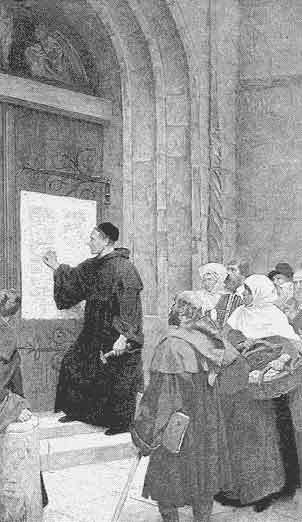
Martin Luther posts his 95 theses
on the doors of the church at Wittenberg


Sola Scriptura

Sola Gratia

Sola Fide

Solo Christo

Soli Deo Gloria!


Wednesday, September 05, 2007

Creed by Steve Turner

Creed
by Steve Turner

This is the creed I have written on behalf of all us.

We believe in Marxfreudanddarwin
We believe everything is OK
as long as you don't hurt anyone,
to the best of your definition of hurt,
and to the best of your knowledge.

We believe in sex before, during, and after marriage.
We believe in the therapy of sin.
We believe that adultery is fun.
We believe that sodomy is OK.
We believe that taboos are taboo.

We believe that everything is getting better
despite evidence to the contrary.
The evidence must be investigated
And you can prove anything with evidence.

We believe there's something in
horoscopes, UFO's and bent spoons;
Jesus was a good man
just like Buddha, Mohammed, and ourselves.
He was a good moral teacher
although we think His good morals were bad.

We believe that all religions are basically the same--
at least the one that we read was.
They all believe in love and goodness.
They only differ on matters of
creation, sin, heaven, hell, God, and salvation.

We believe that after death comes the Nothing
Because when you ask the dead what happens they say nothing.
If death is not the end, if the dead have lied,
then it's compulsory heaven for all
excepting perhaps Hitler, Stalin, and Genghis Khan.

We believe in Masters and Johnson.
What's selected is average.
What's average is normal.
What's normal is good.

We believe in total disarmament.
We believe there are direct links between warfare and bloodshed.
Americans should beat their guns into tractors
and the Russians would be sure to follow.

We believe that man is essentially good.
It's only his behavior that lets him down.
This is the fault of society.
Society is the fault of conditions.
Conditions are the fault of society.

We believe that each man must find the truth that is right for him.
Reality will adapt accordingly.
The universe will readjust.
History will alter.
We believe that there is no absolute truth
excepting the truth that there is no absolute truth.

We believe in the rejection of creeds,
and the flowering of individual thought.


"Chance" a post-script

If chance be the Father of all flesh,
disaster is his rainbow in the sky,
and when you hear

State of Emergency!
Sniper Kills Ten!
Troops on Rampage!
Whites go Looting!
Bomb Blasts School!

It is but the sound of man worshiping his maker.


as heard on The Search for Absolutes in a Pluralistic Society (Part 3 of 3) on "Let My People Think" featuring Ravi Zacharias (I downloaded the series free from iTunes)

Sunday, April 08, 2007

Poem - The Day of Rusurrection by St. John of Damascus

The Day of Resurrection
by St. John of Damascus

'Tis the day of resurrection,-
Earth, tell it out abroad,-
The passover of gladness,
The passover of God.
From death to life eternal,
From this world to the sky,
Our Christ has brought us over,
With hymns of victory.

Our hearts be pure form evil,
That we may see aright
The Lord in rays eternal
Of resurrection-light,
And, listening to his accents,
May hear, so calm and plain,
His own "All hail!" and, hearing,
May raise the victor-strain.

Now let the heavens be joyful,
Let earth her song begin,
Let the round world keep triumph
And all that is therein,
Invisible and visible,
Their notes let all things blend;
For Christ the Lord hath risen,
Our joy that hath no end.

He is risen! He is risen indeed!


Saturday, April 07, 2007

Poem - Psalm 22

David subtitled this Psalm "A Cry of Anguish and a Song of Praise". Is it any wonder that the Son of God used these words at the time of His anguish? These words that the Holy Spirit placed into the heart of David hundreds of years before. Should we not utter them as we reflect on the mercy we were shown in that pain as we praise the One who allows us the honor of singing His praises from our unclean lips?


Psalm 22
(NASB)

1My God, my God, why have You forsaken me?
Far from my deliverance are the words of my groaning.
2O my God, I cry by day, but You do not answer;
And by night, but I have no rest.
3Yet You are holy,
O You who are enthroned upon the praises of Israel.
4In You our fathers trusted;
They trusted and You delivered them.
5To You they cried out and were delivered;
In You they trusted and were not disappointed.
6But I am a worm and not a man,
A reproach of men and despised by the people.
7All who see me sneer at me;
They separate with the lip, they wag the head, saying,
8"Commit yourself to the LORD; let Him deliver him;
Let Him rescue him, because He delights in him."
9Yet You are He who brought me forth from the womb;
You made me trust when upon my mother's breasts.
10Upon You I was cast from birth;
You have been my God from my mother's womb.
11Be not far from me, for trouble is near;
For there is none to help.
12Many bulls have surrounded me;
Strong bulls of Bashan have encircled me.
13They open wide their mouth at me,
As a ravening and a roaring lion.
14I am poured out like water,
And all my bones are out of joint;
My heart is like wax;
It is melted within me.
15My strength is dried up like a potsherd,
And my tongue cleaves to my jaws;
And You lay me in the dust of death.
16For dogs have surrounded me;
A band of evildoers has encompassed me;
They pierced my hands and my feet.
17I can count all my bones.
They look, they stare at me;
18They divide my garments among them,
And for my clothing they cast lots.
19But You, O LORD, be not far off;
O You my help, hasten to my assistance.
20Deliver my soul from the sword,
My only life from the power of the dog.
21Save me from the lion's mouth;
From the horns of the wild oxen You answer me.
22I will tell of Your name to my brethren;
In the midst of the assembly I will praise You.
23You who fear the LORD, praise Him;
All you descendants of Jacob, glorify Him,
And stand in awe of Him, all you descendants of Israel.
24For He has not despised nor abhorred the affliction of the afflicted;
Nor has He hidden His face from him;
But when he cried to Him for help, He heard.
25From You comes my praise in the great assembly;
I shall pay my vows before those who fear Him.
26The afflicted will eat and be satisfied;
Those who seek Him will praise the LORD
Let your heart live forever!
27All the ends of the earth will remember and turn to the LORD,
And all the families of the nations will worship before You.
28For the kingdom is the LORD'S
And He rules over the nations.
29All the prosperous of the earth will eat and worship,
All those who go down to the dust will bow before Him,
Even he who cannot keep his soul alive.
30Posterity will serve Him;
It will be told of the Lord to the coming generation.
31They will come and will declare His righteousness
To a people who will be born, that He has performed it.


Thursday, March 15, 2007

Free Conference Online

Ligonier Ministires 2007 National Conference Webcast
Contending for the Truth

March 15-17
(free registration required)

Speakers include:
R.C. Spoul
Ravi Zacharias
John MacArthur
Al Mohler
John Piper


Friday, February 23, 2007

Modesty

Heather at Stepping Heavenward linked to the results of a Modesty Survey on the Well-Trained Mind Message Boards today. A wonderful 'virtual discussion' arose as a result, and one woman's series of posts particularly struck me. I thought I would share my response to her here. (Apparently, this is my day for writing. I am sure that it has everything to so with sore muscles that have kept me cuddling my heating pad on the sofa for the majority of the day. I promise I will post the final Women in the Church post soon. Honest. In the meantime, read this. Think. Respond.)

**********

I was particularly struck by your posts in response to the modesty study .

To be completely honest, I did not read the study results. I’ve been a teenage girl who dated teenage boys and I married a healthy, heterose*ual male who has eyes and natural inclinations and is very open talking with me about them. I’ve walked through the local mall and along American beaches. I watch TV. I have observed and experienced what men/ teenage boys find attractive, distracting, etc.

I first read your response stating that you wanted to do a word study in Scripture on the word “lust”. That would be a very interesting study! I am sure it would lead to exaggerated desires of all kinds and not just s*x. What struck me about that post was your statement “I just can’t conceive of a God who would both create a visually stimulated gender and also set His creation up for sin by making lust sin.”

I completely agree with you that our passions are given to us by God and that the male body was created with woman’s pleasure in mind and visa versa (this is evident in Song of Solomon). However, I don’t believe that we were “set up” by God. We were given desire and passion as a gift. Lust is the perversion of that passion. If God created everything and without sin, then sin must be perversions of things that were created… evil is a perversion of good, lust is a perversion of se*ual desire, obesity/ gluttony is a perversion of sustenance/ feasting, etc. God’s plan was for man to desire his wife (I am assuming that all this is visa versa for wives to husbands, but I don’t want to type it every time, so just work with me… *grin*). Obviously, part of man’s choice of a wife will be driven, in part, by who he is attracted to but that attraction has an ultimate goal… to physically join with and have a family with a woman. Ogling models, cheerleaders, or the neighbor’s wife does not further this goal. Will the eyes be drawn in these instances? Probably. Will thoughts fly through the mind? Probably. It is the nature of sin. We are sinners. We can’t help but sin (Romans 5:19-21). However, we do have a choice as to how we respond to our sin. We have a responsibility to confess and repent of it (Ezekiel 18:29-32). As C.S. Lewis more eloquently put it:

You can get a large audience together for a strip-tease act -- that is, to watch a girl undress on the stage. Now suppose you came to a country where you could fill a theater by simply bringing a covered plate onto the stage and then slowly lifting the cover so as to let everyone see, just before the lights went out, that it contained a mutton chop or a bit of bacon, would you not think that in that country something had gone wrong with the appetite for food? And would not anyone who had grown up in a different world think there was something equally queer about the state of the sex instinct among us.

Another comment in that post (“What I usually read in these threads is *extra* Biblical.”), didn’t strike me as much until I read:

I believe, from my own life experience and observation, if acting immorally or in sin is an issue in a person's life, it's between that person and God to change.

I don't believe that a person ready and wanting to change asks *us* to change for them. At least not normal, regular things such as fashionable dress. Or drinking normally. Or normal, healthy use of credit cards. Or using prescription drugs according to doctor's orders.

I completely agree with you that, as Christians, we must analyze these things in the light of Scripture and not in the light of personal experience. Thus, I found it ironic that you chose to argue this next point in light of your personal experience. I, too, have the tendency to pepper my arguments with personal anecdotes. However, when discussing matters of Scriptural obedience, Scripture alone should be argued.

As to the point you make (“I don’t believe that a person ready and wanting to change…”), the Scripture is very clear on this point. Individuals are responsible for their own sin and cannot (and should not) pawn-off the culpability for their sinful actions onto others (it didn’t work for Adam or Eve in Genesis 3:12-19). However, Scripture is also clear that those who have been recipients of Grace have a responsibility to others. Romans 14 discusses principles of conscience. Although we have a great deal of latitude to judge certain issues for ourselves (often referred to as “Christian liberty”) and our thoughtful, Scriptural analysis and conclusion resulting in an act of faith on our part causes our action to not be considered sinful (within the parameters of God), we still have an obligation to the judgments and beliefs of others even if they may be in opposition to our views. Placing our opinion/ conviction second to the opinion/ conviction of a brother shows love and is commanded by God. I Corinthians 10:23-24 puts it more concisely:

All things are lawful, but not all things are profitable. All things are lawful, but not all things edify. Let no one seek his own good, but that of his neighbor.

As Americans, we tend to cling very tightly to our “rights.” No one else can tell us how to dress, what to eat, what music to listen to, who to be friends with, etc. This is a good policy for a government. However, the issue we are discussing is not one of American culture. We are discussing the issue of dress within the context of the Church. As followers of Christ, we have an obligation not to tempt another in their area of weakness. In the specific case of the survey, a group of Christian girls asked a group of Christian boys to express to them what forms of dress may tempt them. The boys obliged. The girls are now responsible to act accordingly with the information. Are they responsible if a boy lusts after them despite how they are dressed? No. Are they responsible to choose their clothes, speech and actions with the righteousness of their spiritual brothers in mind? Absolutely.

I will admit that the “stumbling block” passages have been twisted to support pharisaical behavior. This is another effect of sin. However, because someone misuses the command doesn’t mean that it doesn’t apply. We must remain obedient while at the same time protecting ourselves from pharisaism (Matthew 23:24-26).

This post is getting rather long, and my tired brain is losing track of all the points I was planning to make, so I will leave it at that. Thank you for reading this far and for sharing your opinions (this has been a great thread to read and has brought up great topics for analysis). Please forgive all my typos and weird perversions of grammar.


Wednesday, February 14, 2007

Women in the Church: Addendum

Here are some articles/ books concerning various aspects of the role of women in the church that I have been reading to better prepare myself for the discussion in our Sunday School class that I thought you would enjoy reading for yourselves:

1. The Order of Creation by R.C. Sproul

2. Recovering Biblical Manhood and Womanhood edited by (specifically Chapter 5: Head Coverings, Prophesies and the Trinity: I Corinthians 11:2-16 by Thomas R. Schreiner and Chapter 9:What Does It Mean Not to Teach or Have Authority Over Men?: I Timothy 2:11-15 by Douglas Moo)

3. An Examination of the Seven Pillars on Which the Case for the Permanent Subordination of Women Stands by Kevin Giles

4. “Because of the Angels”: Unveiling Paul’s Anthropology in I Corinthians 11 by Jason David BeDuhn (I was able to access this article via JStor which Frodo was able to access me through his grad school account; I have link to the abstract of the article here, but you may be able to access the article through your library’s online library access if they have a JStor account)

5. On Slippery Slopes, the Blogosphere, and (oh, yes) Women: The Place of Women in the Redemptive Community by Susan Wise Bauer (this is a review of John Stackhouse’s book Finally Feminist which I have not yet read but am looking forward to reading when I get the opportunity)

6. a ‘virtual discussion’ between Susan Wise Bauer and Rick Phillips in the form of a series of blog entries

a. Lecturing, paneling, and parties (SWB)

b. Ref21, Books & Culture, and the Feminist Slippery Slope (RP)

c. Susan Wise Bauer Guest Post (SWB)

7. Women Theologians: A Spiritual Goldmine for the Church by Carolyn Curtis James

8. The Westminster Confession of Faith (specifically Chapter I Section VI)

I hope to have this week's discussion installment up in the next day or two. In the meantime, happy reading!

Saturday, February 10, 2007

Women in the Church: Part 2

Sorry to be posting this so late, but we have all had the flu, so I am behind in posting, laundry, washing dishes, etc. Hopefully, Frodo or I will be well enough to go to this week’s class (manned with my handy-dandy new MP3 player with voice recorder) which will be an in-depth discussion on I Timothy 2. As before, any text in italics is my thoughts and plain text is taken directly from the class.

Review from the previous class:

  1. Jesus was not constrained to cultural norms.
  2. Jesus chose 12 men as His apostles.

Was this strategic? If so, then why choose fishermen, misfits? Why not choose powerful men?

This class turned out to be another one in which many texts were thrown out with very little discussion. The purpose of this class was to examine how women served God, and in what roles, in the Old and New Testaments.

Should there be any restrictions at all on women in the church? This is the question that will be examined at the next class.

Egalitarianism – no distinction between men and women

There is a concern within the evangelical church that if women are accepted in more authoritative roles within the church that it will open the door to homosexuals being accepted into such roles as well since restrictions are placed on both women and homosexuals in Scripture. This stems from the fact that the language which women have used to try to expand their roles within the church was taken from the civil rights movement and this language is now being used by the homosexual community. This causes a slippery slope argument that focuses more on the language of the argument than an examination of Scripture.

This was the extent of the discussion on Egalitarianism. It was spurred by an article I emailed to the pastor in anticipation of this topic being discussed. The article was a review of John Stackhouse’s "Finally Feminist" by Susan Wise Bauer that appeared in Books and Culture. I recommend you read it for yourself since she gives a much better (and more thorough) overview of the egalitarian position than was given above. I have not yet read Stackhouse’s book, but I hope to in the near future and will share my thoughts on it once I have. Lucky you.

Focus on Scripture:

The Greek word “dialconid” is generally translated as either “service” or “ministry” as in Luke 8:1-3, I Peter 4:10 and I Corinthians 12:5

Here begins the tossing out of examples of the various roles of women in God’s service. There is very little discussion, but I have included it where it occurred. These passages were reviewed to show that women did indeed hold positions all along the scale of authority within Israel and the church and to set the stage for the class to follow which would seek to find whether there are differences between the roles that women held and those that men held.

Abigail:

I Samuel 2:5

Was Abigail going over her husband’s head and disobeying him? Nabal was a fool and what she did was good for him.


Judges/ Prophetesses:

Miriam – Exodus 15:20-22 (Miriam gets leprosy and Aaron doesn’t)

Huldah – II Kings 22:14

Deborah – Judges 4:4

Ezekiel 13:17

What is a prophet? One who represented God’s word to the people; direct connection to God

Deborah:

What did Deborah do in her role as a judge? She judged men and exercised authority over them

What is unique about her time as a judge? She didn’t lead an army; she didn’t get the glory (Jael did – another woman); she didn’t rule in a public square (people came to her)

II Kings 22 and Exodus 15:20 show how women exercised authority while not in the public square or with only other women

Luke 2:36 – Anna; a prophetess

Acts 21:9 – Philip’s daughters

Joel 28:32

I Corinthians 11:5 – women prophesy with proper adornment

Acts 18:26 – Precilla and Aquilla correct Apollo’s teaching of the gospel and reteach him

Romans 16:3; I Corinthians 16:19 – Precilla and Aquilla seen as co-laborers with Paul

I Corinthians 12:28 &14:26; Titus 2:3 – what is the order of authority? Women given the gift to teach and to prophesy is the definitive word of God, therefore women should be able to teach God’s word in any context; is this true?

We should be subject to authority of laborers in the church, including women (see Philippians 4:2; I Corinthians 16:16; I Corinthians 4:12; I Corinthians 15:10; Galatians 4:11; Colossians 1:29; I Timothy 4:10)

Women as deacons:

I Timothy 3:11 - Paul introduces women as he did men by using the word “likewise”

Romans 16:1 – “deaconess” (same language as I Timothy 3:8); actually calls the women “deacons”

Women as Elders – II John 1:4

Women as Apostles – Romans 16:7 (Junius is a woman’s name)

I apologize for the disorganized feel of this post. There didn’t seem to be much of an outline to the material presented, so I tried to organize it as best I could. I also am not linking all of the Scripture references as I did last time because this cold/ flu thing has greatly shortened my ability to sit in front of the computer screen. If you want to look-up the passages in an online Bible, I highly recommend BibleGateway. You can search any version of the Bible you’d like. Our church uses the NIV for class and worship purposes, but I linked to the NASB in the last post. I’m looking for a meatier discussion for the next post. Keep your fingers crossed.

Sunday, January 21, 2007

Women in the Church: Part 1

Apparently, our pastor decided that this topic would need more time than was allotted in one class period, so with the knowledge that we would be discussing into at least one additional class period, he spent a lot of time on introduction today. This introduction took the form of listing a lot of Scripture references and questions to go with them for us to ponder over the next week in preparation for the next class. I will attempt to present the information as clearly as I can here, but please take these passages and questions and study them yourselves. Hopefully, all this will become clearer and easier to discuss/ debate after next week’s class.

*A reminder before I get to the lesson: Please feel free to leave comments, thoughts, questions, etc. in the comment section (be considerate in your presentation, please). Don’t forget that if you receive these posts by email that you will have to come on over to the actual blog to post a comment. If you simply reply to an email, I and all the other email recipients will receive your response, but not blog readers.

Italics indicate an interjection of my own thought, comment or opinion.

Some questions that have been asked in regard to the role of women in the church:

  1. Why is the difference between men and women so important?
  2. What is meant by “unbiblical female leadership”?
  3. How did Jesus treat women? Did He acknowledge (and thus condone) the hierarchical tradition? Did He give women access to all levels of His ministry?
  4. Paul mentions women in teaching roles. In what areas and whom were they teaching?
  5. How can women prophesy in church yet not be pastors?
  6. How can women be silent in church and prophesy?
  7. Galatians 3:28 states “There is neither Jew nor Greek, there is neither slave nor free man, there is neither male nor female; for you are all one in Christ Jesus.” Huh?
  8. God endorsed female judges in the Old Testament. How does this reconcile with the teaching of women’s roles in the New Testament?

Adam was created with a ‘design deficit’. He was alone and this was not good. He needed a helper. God allowed Adam to discover this lack on his own by presenting him with all of the animals to name and allowing Adam to discover that none was a suitable helper. With this knowledge provided, God created Eve as a help-mate for Adam.

What comes to mind when we hear the word “help-mate”? “Submission” was the general response. The pastor was really bolting through this material, so I did not have a chance to offer my response, which is “power” and “relief”. We have all heard the phrase, “Man is the head, but woman is the neck”, and I think that there is great truth in this statement. Women have a great deal of power in their marital relationship (which is what we are talking about when we are discussing help-mates). I know that my opinion holds great influence with my husband. Also, men tend to be more analytical and women more emotional, so we have a great ability to influence the directions of our husbands… to manipulate, to be completely frank. Thus, a help-mate wields great power. The relief comes in because, although I have all this power, I do not carry the majority of the burden. My children are responsible for their own spiritual states. I am responsible for my own spiritual state and, to a large extent, the states of my children. My husband, however, shoulders the burden of his own spiritual state and those of myself and my children. The concept of “the buck stops here” applies in spades to the head of the family. Thus, a help-mate has some relief, for she does not have to bear the full burden of the one over whom she has great influence. The help-mate is a completer. Adam is more “Adam” because of Eve. However, they are still individuals. Thus, the distinction between the sexes exists from Creation.

This is where a list of Scriptures and questions gets thrown out there with basically no discussion or comment. Just keep them in the back of your mind, ponder them through the week (I will be doing the same), and, hopefully, some of those questions and comments begging for answers will receive those answers next week.

I Corinthians 11:1-22

Is the concept of the head covering cultural?

How would one define “long hair”?

Is a shaved head culturally symbolic?

What does the term “head” mean as it appears in verse 3?

How does this passage apply today?

At this point, the pastor drew a diagram on the board of a cone (point up) that he called the “cone of certainty”. The closer to the top (point), the more certain he was of something (such as Christ being Savior) and he would be willing to die for it. Near the center of the cone were those things he held to be true (i.e had a personal conviction about) but was not certain of. He stated that the role of women in the church would fall in the middle of the cone for him. He stated that it was enumerated in Scriptures, but not as law, only as wisdom. I am afraid I see where this is going, but I will hold-off judgment until we discuss the topic in detail next week. To be honest and upfront in my presentation, I should let those of you who do not know me well that I wear a heard-covering in formal worship (formal worship= anything inclusive of a call to worship).

What does it mean to be ordained?

Is it simply a question of giftedness, or is it also a question of authority?

I Corinthians 14:34-35, Galatians 3:28, I Timothy 2:11-15 (in which Paul appeals to Creation)

How does Jesus treat women?

Jesus spoke to them. It was against cultural custom at the time to speak to a woman in public who was not his wife or daughter. It shows respect on the level of a man.

John 4:27, John 7:24, John 7:11-13, Luke 8:48, Luke 23:27-31

Luke 13:16 -> Jesus expresses great respect by calling the woman a “daughter of Abraham”

John 8:10-11 -> however, coupled with this show of respect is a willingness to not gloss-over a woman’s sin

Luke 7:44-50

In the Old Testament, lust wasn’t really a sin, but in Matthew 5, Jesus equates it to adultery

Also in the Old Testament, men could divorce, but women could not. This left many women destitute. Jesus stated that all divorce (with one caveat) was sinful.

Frodo and I both had problems with these statements. Mine was more of a gut reaction, but Frodo was more eloquent in our discussion on the way home, so I will let him elaborate on this when/ if he gets opportunity to do so. (Are you reading this, hon? Hint, hint.)

John 19:26-27 -> Jesus provided for His mother at the time of His crucifixion

Matthew 24:31

Luke 18:1-5

Women were used as examples of how we should act. One of these lessons was in the story of Mary and Martha where Jesus makes clear that women should sit under His teaching.

Women were the first to encounter the resurrected Christ. It was counter-cultural for women to be witnesses. Jesus used their action of performing their womanly duty (i.e. taking care of the dead) and used it to promote them from mourners/ caretakers to witnesses.

Despite all the ways in which Jesus treated women counter to the way they were treated culturally (lifting them higher than they were generally regarded), He still recognized distinct sexual roles. Luke 6:12-16 -> only men were chosen to be apostles with the knowledge that they would be the leaders of the first century church. According to Matthew 19:28, they were closest to Christ with special positions in Heaven. They were given a specific, earthly teaching ministry.

With this, a tense discussion began (this is guaranteed to happen when there are -2 minutes left in the class). One member of the class expressed the opinion that, given how men and women were regarded at the time (mentioning specifically the idea of women not being considered worthy of being witnesses), that Jesus had to choose male apostles because the message of the Gospel would not spread through women in a culture that did not value their opinion or what they had to relate. There was a great deal of agreement with this opinion. Our pastor felt that this could not be the case because Jesus had so obviously countered cultural views of women in His interaction with them without concern for how it would effect His message that He could have chosen female apostles if He had wanted to, so He must have chosen men for a reason. Precedent. Appeal to Creation. Something. This did not go over well. We will have to see where this discussion goes when we resume it next week.

BTW, if you find any broken links, please let me know (leave a comment or email me). I put the links in last when I was tired, so I may not have entered them correctly. Thanks.